Header

Showing posts with label historic preservation. Show all posts

Saturday, August 15, 2020

Kim Dudgeon named to Historic Properties Commission

Kim Dudgeon
Kim Dudgeon of Midway is one of two new appointees by Gov. Andy Beshear to the state Historic Properties Advisory Commission, which is responsible for management and conservation of the state Capitol, the Executive Mansion and the Old Governor's Mansion.

The commission was in the news recently after Beshear asked it to recommend removal from the Capitol rotunda the statue of Confederate President Jefferson Davis, which had been installed in 1936, before the commission was created. The commission voted to recommend removal, and the only "no" vote was cast by Brandon Wilson of Somerset, whom Beshear replaced with Dudgeon, owner of The Milam House.

Another new appointee was Kenny Bishop of Lexington, the legislative liaison for Transportation Secretary Jim Gray. Bishop was a personal aide to Gray when he was mayor of Lexington and previously for then-Gov. Ernie Fletcher. He replaced Jon Park of Lexington, who said his vote to remove the statue was "reluctant." Park and Wilson were appointed by Republican Matt Bevin, whom Beshear beat in last fall's election; their terms had expired.

Beshear reappointed the commission chair, Steve Collins of Shelbyville, the son of former Gov. Martha Layne Collins. He, Bishop and Dudgeon were appointed to terms expiring Aug. 11, 2024.

Monday, June 29, 2020

Messenger's latest print edition has several new stories: water quality, features on people and businesses, more

Download a 5 MB PDF by clicking here.
The Midway Messenger is primarily online, but publishes a print edition twice a year, with stories of lasting interest, including some that haven't appeared online yet. The latest one, being distributed in town tonight and Tuesday, has several stories that you haven't seen before.

We covered the Midway mask project at several junctures, but now we wrap it up with a start-to-finish story, aggregated by University of Kentucky student Emmanuel Flemister and boosted by Editor-Publisher Al Cross's interview with Amy Bowman of Midway Makers Market, who came up with the idea.

Also on the front page is an illustration leading you to a story inside about the water quality of the streams of Midway: South Elkhorn Creek and the town tributary, Lee Branch. UK student Lauren McCally looked at the latest water samples and interviewed people about the streams, which are getting cleaner.

UK student Madison Dyment has a knack for feature stories, and the print edition has two new ones: about former Secret Service agent Danny Smith and the Freedman's saddlery shop, which has only one other location: Toronto. As luck would have it, Maddi is a Canadian from near that city.

Some previously published stories have been updated, such as the one on the new Weisenberger Mill bridge (with a drone photo offering a fresh perspective) and UK student Hayley Burris's report on the latest outbreak of the disease that causes Thoroughbred mares to lose their foals.

On the last spread of the print edition, we republish a story and some photos from the Midway Chalk Day for Racial Justice, and recount other examples of how Midway became in the national movement for racial reckoning that has seized much of the nation in the past month.

The print edition is available at the post office tonight and Tuesday morning, and will be distributed to City Hall, retail stores and restaurants on Tuesday. It is free of charge.

Friday, June 19, 2020

Owner of historic building has until Oct. 31 to fix it up

116 E. Main St. in January 2019; little has changed.
By Emmanuel Flemister
University of Kentucky School of Journalism and Media

The owner of the condemned building at 116 E. Main St. has until the end of October to fix up the rundown landmark or face the likelihood of the city tearing it down.

Woodford County planning and zoning officials had given Ness Alamdari of Lexington until March 30 to correct 10 issues with the building, as cited by Building Inspector Joshua Stevens on Feb. 10.

The deadline was extended to Oct. 31 after a consulting engineer for Alamdari submitted a letter, dated March 17, saying that the structure was stable. That headed off a possible order of demolition.

Mayor Grayson Vandegrift told the City Council and the news media March 24, “At the end of this extension, he must have the property approved by a certified engineer, who in turn would be taking liability for the structural integrity of the building.” The property has become a “threat to public safety,” Vandergrift said earlier.

If Alamdari fails to meet these requirements, the process becomes “very burdensome for him,” said Vandergrift. “He would essentially have to start the process over with the Board of Architectural Review,” which set conditions for renovation of the property soon after Alamdari bought it in 2016. “If he fails in these obligations, I will be pushing for condemnation.”

Alamdari is still operating under a building permit that was issued in April 2018 and listed the cost of repairs at $20,000.

The property has been a trouble spot since at least 2006, according to Planning and Zoning Commission records. Vandegrift asked for the Feb. 10 inspection. “As a government, we were very patient with him for a long time,” he said in March.

Alamdari told the Messenger Feb. 19 that Vandergrift wants to tear down the building to make it a parking lot for festivals. Vandegrift denied that.

“I think I took the diplomatic route and probably was erring on the side of patience, just trying to make sure we were working with him,” the  mayor said.

The building was erected in 1898 by the Pilgrim Lodge of the Odd Fellows, an African American men's organization. Local historian Bill Penn, a nearby store owner, said it was last occupied 15 to 20 years ago. It is a landmark in Midway’s African American community, but is also one of the most prominent examples of blighted property in Midway, due to its downtown location and severe condition.

The mayor said he would take no pleasure in demolition of a historic stricture, but “I have been inside the building, and like so many others have watched as time and weather continue to deteriorate it . . . I came to believe that condemnation is the only solution.”

Vandegrift said that if the situation isn’t resolved by Oct. 31, one last alternative to demolition could be putting the property the city’s list of abandoned urban properties, which would be done by the city’s new Code Enforcement Board. The list is due to the City Council for review by Jan 1, 2021. Properties on the list are taxed at a much higher rate.

“If this building didn’t have such historical significance, I would likely disagree with this step,” he said. “But if one last-ditch effort to save this structure is what it takes, then we’ll proceed with a keen eye and a stern voice. We will continue to ensure that the citizens of Midway will not be taken advantage of, but we will also willingly follow the letter of the law in both protecting the rights of owners and the safety of our residents and visitors.”

Friday, May 8, 2020

Pandemic makes Weisenberger Mills busy: 'Everybody wants flour that hasn't ever used any,' Mac says

A photo taken Wednesday shows the mill, creek, dam and, at left, part of the"shotcrete" abutment for the new bridge. 
A Weisenberger mill has stood on the Scott County bank of South Elkhorn Creek near Midway since 1865, and the current mill has been there since 1913. It has become a timeless icon in Central Kentucky, but it is also a business, and at a time when many businesses are closed, it is busy -- for the same reason a lot of Kentuckians are not. They're home, and they're baking.

"Things are really busy here," Mac Weisenberger, the fifth-generation owner of Weisenberger Mills, said in an email Tuesday. "Everybody wants flour that hasn’t ever used any. The website orders are almost overwhelming for now."

The mill was somewhat isolated for almost three and a half years because the state, citing safety concerns, closed the 80-year-old bridge that crossed the creek just downstream from the mill dam. After debates about how many lanes the bridge would have, and going through a long historical and environmental review, property negotiations and a rebidding, a new one-lane bridge opened Dec. 23. For a story and video on the ceremonial ribbon-cutting, click here.

Friday, December 20, 2019

Weisenberger Mill bridge about ready for Mon. opening

Bill Jenkins of the Woodford County Road Department walked across the new Weisenberger Mill bridge yesterday morning. The department's Tom Fortenberry said the bridge will be ready for traffic, once state contractor Louisville Paving Co. installs the ends of guardrails.

Louisville Paving posted signs at the Scott County junction of US 62 and 421 saying that the bridge will open Monday, Dec. 23, but the state Transportation Cabinet has been unwilling to guarantee that. Construction went faster than expected largely because of favorable weather, Fortenberry said.

The state is paying for the bridge under a long-ago trade with Woodford County, which is responsible for the bridge under a previous agreement with Scott County. (South Elkhorn Creek is the county line.) The Woodford County Road Department was responsible for blocking traffic and posting signs after the state closed the bridge for safety reasons on July 1, 2016.

Replacement of the bridge was delayed by historical and environmental concerns. In response to concerns by nearby residents who feared a two-lane bridge would lead to more speeding and wrecks, especially in the curve on the Woodford County side, the state contracted for a one-lane pony truss bridge much like the one built in 1935.

Tuesday, December 17, 2019

Weisenberger Mill Bridge scheduled to open Dec. 23, contractor says; state not willing to promise that

The new bridge structure was placed Nov. 25. (Image from
video shot by Phil Weisenberger, from Weisenberger Mill )
Midway Mayor Grayson Vandegrift announced near the end of last night's City Council meeting that the new Weisenberger Mill bridge could open to traffic before Christmas, months earlier than long thought.

Vandegrift said he had heard from "state officials" and Scott County Magistrate Chad Wallace that "unless something just terrible happens, unexpected, Weisenberger Mill bridge will be open by Christmas Day."

That brought cheers in City Hall, because the bridge has been closed for safety reasons since July 1, 2016, and its replacement has been delayed by environmental and historical considerations. The new bridge was expected to open by May, but construction has proceeded quickly.

Asked if the bridge could be open by Christmas, state Transportation Cabinet District 7 spokeswoman Natasha Lacy said in an email this morning, "There is a possibility for this. However, I will not send out an advisory until we receive final word from the contractor." Asked how long before traffic opening  the advisory would go out, she said "We do not know at this time because of the inclement weather."

UPDATES: The state contractor, Louisville Paving Co., has posted signs saying that the bridge will be open to traffic Dec. 23. Lacy said Wednesday morning, "The contractor did set up variable message boards with the date of the 23rd. However, guardrail work has not been completed. I will send a news release when we (the District 7 Office) are confident that the road/bridge will be open to motorists."

Monday, November 25, 2019

Bridge placed at Weisenberger Mill; long-delayed project is on target for expected completion in May

Just as a crane lifted the old, dilapidated Weisenberger Mill bridge off its moorings on Aug. 30, one lifted a new one from a stretch truck and placed it on the recently strengthened abutments. Phil Weisenberger shot a video from his family's mill and sped it up for easier viewing. This is one frame.

For long-debated reasons of historic preservation and safety, the new bridge is a one-lane, pony truss, much like the old one. The project is expected to be completed in May, just in time for the summer tourist season. The bridge over South Elkhorn Creek, where a mill and scenic dam have stood since 1865, is a favorite stop in the Bluegrass.

The state's contract with Louisville Paving Co. gives the firm until July 26 to complete the project, but highway officials said after meeting with the contractor that they expected it to be open by May. Natasha Lacy, spokeswoman for the district office of the state Transportation Cabinet, said Tuesday that the project is on schedule and Louisville Paving would like to complete the bridge itself by Jan. 1. She said that is possible with favorable weather, but approaches to the bridge are also part of the contract, and "They take time to pave, and compact fill correctly. Sidewalk and signs have to be installed as well."

Saturday, August 31, 2019

More videos and photos from the 'pick' of the Weisenberger Mill bridge

This video was taken from just above the mill dam. For the completion of the "pick," as the move was called, go to Midway Messenger reporter Dalton Stokes' story, below or here.
Crane operator Joe Fisher (yes, really) of Taylorsville fished as he waited for other workers to finish preparations for the pick. He said he had fished in all manner of waters, never in Elkhorn Creek, but when he visited the site the day before, he said to himself, "I'm going to make a few casts." In ideal conditions, he caught five largemouth and one smallmouth bass, all too small to keep.
Jay Weisenberger waited at his vantage point for the work to begin. His family has operated a mill at the site since 1865; the current building was erected in 1913, partly with stone from the original mill. It is no longer directly powered by water; water flowing from the creek behind the dam drives a generator that contributes to the electric power used to run the mill.
Below, a wider shot taken at about the same time, showing the crane, the mill, the dam and the creek.


Friday, August 30, 2019

After 84 years, there is no bridge across South Elkhorn Creek at Weisenberger Mill; new one to be done by May

Story and Vimeo video by Dalton Stokes
University of Kentucky School of Journalism and Media

After six years of debates and preparations, the Weisenberger Mill bridge was removed from its moorings with a 550-ton crane at around 11 a.m. Friday.

A handful of spectators gathered to watch the crane lift the 84-year-old bridge over the corner of the mill and onto a trailer bed. Many spectators were part of the Weisenberger family who had come to see the bridge that they had known all their lives to be lifted and hauled away.

Among them was Phil Weisenberger, who manages the family-owned mill. He said the bridge “had always been there, and it was strange to leave, but time marches on.”

Doug Elam, a neighbor to the bridge on the Woodford County side of South Elkhorn Creek, said  “It Looked like the Macy’s Thanksgiving Day parade with a balloon” as the crane slowly swung the bridge through the air on a sunny morning.

Crane operator Joe Fisher visits with Kristey and Susan
Weisenberger after "picking" the bridge. (Photo by Al Cross)
The crane that "picked" the bridge, as engineers say, was from Sterett Crane and Rigging, based in Owensboro, and manned by crane operator Joe Fisher of Taylorsville, who caught a few bass in the creek before his part of the job began.

He said the crane measured the bridge’s weight at 52,300 pounds,  much heavier the 37,000-pound estimate given by Roger Wade, a structural engineer for Louisville Paving and Construction, the main contractor on the project. He said there were more asphalt and probably less rusted steel than he estimated.

The job wasn’t as easy as just picking up the bridge with the crane, putting on the truck bed and hauling it off. The tractor-trailer was too long to turn around, so the tractor and trailer were separated, and while the tractor turned around, Fisher and workers flipped the trailer around. Kentucky Utilities also had to de-energize overhead power lines for safety.

The bridge is to be rebuilt by May 2020 as most in the community requested, as a pony truss one-lane bridge much like the original. It was argued by some of the community in the decision-making process that the bridge should stay a one-lane bridge as opposed to a two-lane bridge to force southbound drivers to slow down for the sharp curve on the Woodford County side.

The bridge has been marked for either renovation or replacement since 2010, and required public meetings and studies because it is a state project. Woodford County is responsible for the bridge, but the state assumed control in return for the county doing some work for the state several years ago. Before any decision could be made, the damage from heavy trucks forced state engineers to close the bridge on July 1, 2016.
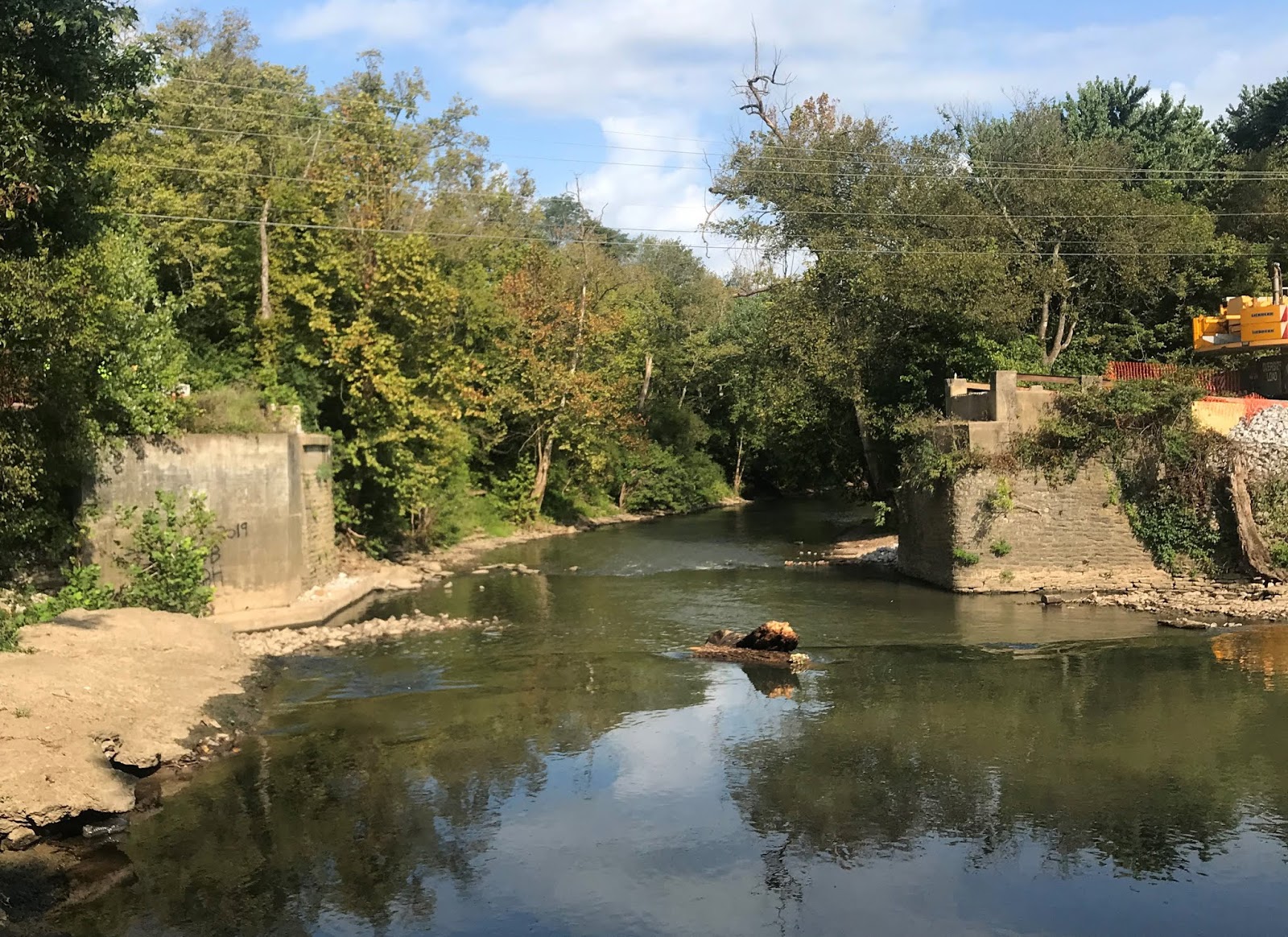
When the work was done, the view from above the mill dam looked very different than it had since 1935. (Photo by Al Cross)

Thursday, August 29, 2019

Removal of Weisenberger Mill bridge is set for Friday

Thursday evening, the crane was in place for Friday's work. (Photo by Al Cross, Midway Messenger)
The steel structure of the Weisenberger Mill bridge will be removed by a crane Friday to make way for the new bridge, the state Transportation Cabinet announced in a press release.

"Louisville Paving Co. Inc. will take out the steel truss between the hours of 8 a.m. and 5 p.m. tomorrow. The time frame for lifting by crane to transfer truck is approximate," the release says. "Kentucky Utilities will de-energize the overhead power lines pending appropriate weather and temperature conditions." The weather is forecast to be sunny in the morning and partly cloudy in the afternoon, with temperatures rising from 66 degrees at 8 a.m. to 87 degrees in late afternoon.

Louisville Paving will move the bridge, which was built in 1935, to its yard. The new bridge will be built in a similar "pony truss" style because the State Historic Preservation Office deemed the site to be eligible for inclusion in the National Register of Historic Places.

The bridge has been closed since July 1, 2016 because of damage caused by heavy trucks. Its replacement was delayed by required hearings, historical and environmental studies, and right-of-way acquisition.
A Transportation Cabinet photo earlier in the day shows the lifting supports installed across the top of the bridge.

Thursday, August 15, 2019

Work starts on new Weisenberger Mill bridge

Work began this week on the new bridge over South Elkhorn Creek at Weisenberger Mill. This photo, looking south from the mill side, shows construction of a temporary road for a crane that will be used to remove the 1935 bridge for replacement with one of a similar style. The state Transportation Cabinet says the work by Louisville Paving Co. is expected to be completed by May 2020. The bridge has been closed for safety reasons since July 1, 2016, and its replacement was delayed mainly by required historical and environmental studies.

Wednesday, August 7, 2019

New Weisenberger Mill bridge set for completion by May

A new Weisenberger Mill bridge should be open by May 2020, the state Transportation Cabinet announced today after meeting with the contractor on the project.

"Preliminary operations begin Monday, August 12," the cabinet said in a news release. "The public will be informed of progress toward the replacement bridge through advisories furnished to media outlets." The first step will be removal of the old bridge, which has been closed for more than three years, blocking a popular tourist and commuter route and delaying emergency responses.

Louisville Paving Co. Inc. was the sole bidder for the project through two rounds of bidding. Its latest bid of $877,000 was almost 42 percent above the state engineers' estimate, but that was a big improvement over the first bid of $1.95 million, 2¾ times a somewhat higher estimate.

The cabinet decided Friday to accept the bid; it will spend an additional sum for "soil nailing," insertion of reinforcing bars into the banks of South Elkhorn Creek. That part of the work was removed from the bid documents and made part of an overall contract the state has issued for such work.

1935 photo of the bridge (Kentucky Transportation Cabinet)
The bridge was closed July 1, 2016, after state inspectors found advanced deterioration in the lower chord of the truss. The new bridge will be a "pony truss" style like the current one, which is 72 feet long and 12 feet wide. The truss spans about 40 feet. 

Replacing the one-lane span, which dates to 1935, has been complicated. The first plan, in 2013, was for a two-lane bridge, but the cabinet changed it to a one-lane pony truss in response to public concern that a modern concrete span would detract from the scenic nature of the site and encourage speeding, causing accidents in the sharp curve on the Woodford County side.

"The newly constructed bridge will fit within the context of the environment," the news release said. "It will also provide a solution for safe travel to be utilized by citizens and emergency management vehicles."

Since the bridge has historical significance and is a state responsibility, the project had to undergo review by the State Historic Preservation Office and the Kentucky Heritage Council, as well as an environmental impact report to federal officials. Initial bidding on the project was delayed a month by negotiations over construction easements.

The bridge links Woodford and Scott counties. It is nominally Woodford's responsibility, under a longstanding agreement between the counties, but the state agreed to take responsibility for it several years ago.

The bridge's closure has further isolated the largely African American community of Zion Hill, at the southern tip of Scott County. Woodford County has been providing emergency services to the area.

Friday, August 2, 2019

Winchester columnist tells the story of the Grants and their model railroad of Midway, recently restored

Laurine Grant and daughter Jeanine Lister watched the trains run.
By Bill McCann
The Winchester Sun

I grew up with a limited view of the arts—theatre, dance, art, music, and writing, each in their various forms. But I am coming to realize that the arts are actually much wider—from painting a sermon to building a scale-model railroad layout.

Heritage Day, July 27, in Midway honored Laurine Grant of and her late husband Bill for their construction and donation to Midway of an N-scale (9mm track width) model railroad of the town.

Grant, 83, moved to Winchester in August 2018. Before that she lived in Vermont for 15 years. And before that, from about 1997 to 2000, she was a citizen of Midway.

Laurine was married for more than 50 years to William Grant. Bill Grant was a heavy equipment operator in Connecticut for more than three decades, a union member who was able to provide well for his family—particularly during the period from March to November of each year. But during the long Northeast winters, when he was laid off, he was a model railroader.

Bill and Laurine Grant raised four daughters—Shannon, Lisa, Jeanine, and Anne—who after high school mostly scattered to the four winds: Connecticut (Shannon); Kentucky, North Carolina, Texas and Colorado (Anne); Kentucky (Lisa); Arizona and Kentucky (Jeanine). In the course of time grandchildren came, Bill retired, and the couple followed—not the swallows to Capistrano, but visited or lived near their daughters and grandchildren.

During the 1980s, while Bill still worked, Lisa and her family lived in Midway and Bill and Laurine came south for visits. And almost immediately, the model railroader was hooked: Midway, the city a railroad runs through. Suddenly he had a vision: of an N-scale model of Midway for his trains.

After retiring from his construction job, Bill and Laurine moved to North Carolina to be near Anne, her husband and children. Still, Bill was a model railroader. And in 1997, they moved to Midway to be near Lisa and her family; Jeanine and her family lived in Lexington, but the pull of Midway’s trains and ongoing work on the train layout was in their minds when choosing where to live.

By 2000 the layout was complete. So before Bill and Laurine hit the road full-time in an RV camper, they donated their N-scale model of Midway to the town.

In the years since, the layout was stored away. However, this year the Midway Community Model Railroad Project’s plan to restore and expand the layout generated a lot of local support.

Finally, on Saturday at high noon, Mayor Grayson Vandergrift had a dedication ceremony where he began by saying that the community of Midway “embraces its history” as a railroad town. Then he thanked Mrs. Grant for the hard work of she and her husband and the donation of the layout to the community of Midway, before thanking the many local people and businesses that had helped restore and expand the model.

That’s the story of what happened. And as a story, it’s a pretty interesting one.

But by now you must surely have the same question I had when going to the dedication of the layout: Why is this art? You buy some plywood, paint it green, add some tracks, buy plastic buildings and trees and tape or tack them down and you have a model train set. Not so!

Truly, great art, and a large amount of time, was involved in this effort.

Jeanine Grant Lister, who now lives in Winchester, explained that tiny little spikes—“You have to use tweezers and a tiny hammer” to put the spikes in—hold down the rails. “And the buildings were made and painted by my parents, though I did make trees and helped paint the silo.” The silo, she said, was made from “part of a toilet paper roll.”

Pictures of the layout which accompany the article may give you some sense of the artistry involved in painting objects that are scaled between 1:148 and 1:160, so a 6-foot man would be roughly 1/3 of an inch tall! A train car in this scale is only a bit more than an inch tall and a few inches long. The buildings require a delicate touch and great care. Building and painting such people, buildings and scenery is truly an artistic undertaking.

Mayor Vandergrift finished speaking by saying that the Midway railroad layout would have a permanent place of honor in the town “soon.” Then he asked Mrs. Grant to speak.

“Thank you” was all she said, to great applause.

Saturday, July 27, 2019

Railroad scale model a big hit at Midway Heritage Day


People attending Midway Heritage Day on Saturday pretty much knew what the big steam engine would look like, but not necessarily what to expect from the old scale model of Midway, recently restored, with double tracks and trains. It was a pleasant, fascinating surprise, the culmination of a community project that reflected the spirit and heritage of Kentucky's first and still iconic railroad town.

The layout was done in the early 1980s by Laurine and William Grant, who donated it to the city in 2001. A few months ago, Midway Renaissance and several community volunteers joined forces to put it back in shape, and it went on display in the old bank building on East Main Street owned by Amy and Mike Stinnett, who erected a temporary partition to facilitate the display.

View is from north. Card on control box lists volunteers (left column) and sponsors (right column, with in-kind contributions)
Those who played key roles in the restoration included Tommy and Susan Kidwell, who provided the layout benchwork and material that formed the base of the project; and Jim Hoppin, who did the custom modeling of three additions to the layout: Midway Christian Church, the mansion at Parrish Hill Farm and the Kentucky Female Orphan School, now Midway University.

View from northwest shows Parrish Hill, added, in foreground.
"We've been working on it probably since the first of February," said Hoppin, whose experience with dollhouses made him the builder of the three additions. His wife Teresa also worked on the project.

Others listed on the display's volunteer-and-sponsor card were Tom Bensberg (engines), Thomas Bookout (details and supplies), Ron Chesser, Joel Damron, Charles Diamond, Midway Christian Church, Midway Renaissance, Steve and Julie Morgan, National Model Railroad Association Division 10, Bill Penn, Amy Perry, Christy Reaves, Brian Roslowski, Kenny Smith (photographic enhancements), Frank Stevenson (buildings and supplies) and Stew Winstanley (engines and rolling stock).
Model maker Laurine Grant, with hand on chin, watched the trains run from the far end
of the model with her daughter, Jeanine Lister of Winchester. (Photos by Al Cross)

Laurine Grant, who now lives in Winchester, said in an interview that her late husband was an N-scale (9 mm track width) railroad modeler, and they decided to build a model of Midway because one of their daughters lived in the town. They lived in Connecticut at the time but later moved to West Higgins Street in Midway.

Grant said the project took about two years, done in bits and pieces, starting with photographs of buildings when they were in town to visit their daughter. "If you are a model train person or a train person, Midway was the ideal place to model," she said.

Jim Hoppin
The model was the usual 4x8-foot module used in N-scale shows, in which modules are arranged in an oval and are connected by tracks over which trains run through them. The first step in restoring it was to make it an independent display, with its own trains.

That required a whole new base, which the Kidwells provided "Without them, we would have never had it," said Reaves, who is a model railroader and calls herself "the Midway train lady." The new layout had extra room, so the volunteers decided to add the three buildings Hoppin built.

Grant said, "I thought it was wonderful. They did a very good job. . . . It's tremendous. I was very impressed and very honored."
View from the west, with history of the railroad, which was established in 1833 and reached Midway in 1835.

Old steam engine, restored scale model of Midway with trains highlight Midway Heritage Day

It's Midway Heritage Day, and trains abound in Kentucky's first and still iconic railroad town. Chesapeake & Ohio Steam Engine No, 2716 arrived from Frankfort shortly after 9:30 and will be here until 1, when it leaves for Lexington, Winchester and Ravenna, its permanent home.
The other special treat of the day is the restored scale model of Midway, complete with the old double tracks and trains. More later on that, but here's a photo. More will appear later.
The day will include this evening with the second installment of Midsummer Nights in Midway.

Friday, July 26, 2019

Midway Heritage Day will start with a steam engine, end with the latest edition of Midsummer Nights in Midway

Chesapeake and Ohio Railroad Steam Engine No. 2716 is scheduled to be on display in Midway from 10 a.m. to 1 p.m.
Saturday, January 27, is Midway Heritage Day, a festival centered around the visit of a historic locomotive that hasn’t visited the region in more than 60 years.

The City of Midway, Midway Renaissance and the Midway Business Association are sponsoring the day in conjunction with the morning arrival of Chesapeake and Ohio Railroad steam locomotive No. 2716. The event will include live music, food vendors, historical displays and walking tours, including a look at the massive engine.

The 400-ton locomotive is scheduled to be on display in Midway from 10 a.m. to 1 p.m. The schedule is subject to change. It is scheduled for display in Lexington from 3 to 6 p.m. A full schedule of events and public display locations is available at www.kentuckysteam.org.

The engine is being moved from the Kentucky Railway Museum at New Haven to be restored at the new Kentucky Rail Heritage Center in Estill County, a project of the nonprofit Kentucky Steam Heritage Corp. The locomotive’s move is a mobile kick-off for the project. The journey will end with a ceremony in Ravenna at 3:30 p.m. Sunday.

Collaborators are CSX Transportation, which owns the railroad bed, and RJ Corman Railroad Group, which leases it. “Working with Midway is always a pleasure, and their willingness to host this unique and fun event brings us even more excitement for the move,” Corman President Ed Quinn said.

A photo of the Midway scale model before restoration
The engine will be accompanied by two other pieces of CSX heritage, both recent special projects of the company's locomotive shop in Huntington, W.Va. The train will be led by a 1948 Clinchfield 800, an F-7 diesel-electric locomotive that was restored and repainted by CSX and is operated by the Southern Appalachia Railway Museum. The train will have a 50-year-old caboose that was donated to Kentucky Steam earlier this year after a complete restoration in Huntington.

Displays will include a 1950s scale model of Midway that Reaves and others have been restoring for several months.

Engine 2716 was built in 1943 and visited the Bluegrass Region frequently until its retirement in 1956. It was one of the largest locomotives to ever run on the line between Louisville and Ashland. After being retired, it was donated to the Railway Museum. Kentucky Steam Heritage leased it in 2016 with plans to run it on excursions and use its operation as an educational tool in Ravenna.

Saturday will also be one of Midway Renaissance's "Midsummer Nights in Midway," with entertainment and vendors from 6 to 10 p.m. Renaissance President Christy Reaves said the news of the locomotive’s visit prompted the idea of Midway Heritage Day to revolve around the history and culture of Midway, Kentucky's first town created by a railroad.

Both nonprofits will have booths at the event, promoting rail tourism on both sides of the state. For more info about the Kentucky Railway Museum, visit www.kyrail.org. Further information on Midway Renaissance is at http://MidwayRenaissance.com.

Weisenberger Mill bridge project gets same bidder, lower price, but still well above engineer's estimate

The second round of bidding for a new Weisenberger Mill bridge drew the same lone bidder, who bid much lower but still well above the estimate of state Transportation Cabinet engineers.

Louisville Paving bid $877,000 for the work, almost 42 percent above the estimate of $618,959. Still, that was a big improvement over the first bid: $1.95 million, 2¾ times the estimate of $709,889. The estimate was lowered because the soil-nailing part of the project, insertion of reinforcing bars into the creek bank, was removed and made part of an overall contract the state has issued for such work.

The Transportation Cabinet is expected to decide in about a week whether to accept the bid for the long-delayed project to replace a bridge that was closed more than three years ago.

After the first bid, Woodford County Magistrate Jackie Brown said Kelly Baker, the chief engineer at the cabinet's District 7 office in Lexington, told him that Louisville Paving bid on foundation work they would not have to do, and expected that a rebid would be much closer to the estimate.

The bridge across South Elkhorn Creek, the border of Woodford and Scott counties, is nominally Woodford's responsibility, under a longstanding agreement between the counties, but the state agreed to take responsibility for it several years ago.

The state closed the bridge July 1, 2016, after inspectors found it was not safe for a load of three tons. The state had already lowered the limit twice in an effort to turn away heavy trucks whose drivers used the bridge for a shortcut to or from Interstate 64.

The bridge's closure has further isolated the largely African American community of Zion Hill, at the southern tip of Scott County. Woodford County has been providing emergency services to the area.

Replacing the one-lane span, built in the early 1930s, has been complicated. The first plan was for a two-lane bridge, but the cabinet changed it to one lane, with the pony-truss style of the old bridge, to assuage public concern that a modern concrete span would detract from the scenic nature of the site and encourage speeding, causing accidents in the sharp curve on the Woodford County side.

Since the bridge has historical significance and is a state responsibility, the project had to undergoreview by the State Historic Preservation Office and the Kentucky Heritage Council, as well as an environmental impact report to federal officials. The project was delayed at least a month by negotiations over construction easements.

Friday, June 28, 2019

State rejects only bid for new Weisenberger Mill bridge, says it will re-advertise for bids to be made by July 26

The bridge is a scenic, historic spot due to the mill, built in 1913 on the site of an 1865 mill, and its dam on South Elkhorn Creek.
The Kentucky Transportation Cabinet on Friday rejected the only bid for construction of a new Weisenberger Mill Bridge, which was almost three times the engineers' estimate but may have been made in error.

The cabinet will advertise the project for bids to be awarded after its July 26 bid letting, said Natasha Lacy, spokeswoman for the cabinet's District 7 office in Lexington. Construction is expected to take six to nine months.

Monday will mark the three years since the cabinet closed the bridge for safety reasons. The bidding was the latest in a series of delays for efforts to replace it with a new bridge.

The bid by Louisville Paving Co. was $1.95 million, 2¾ times the estimate of $709,889. Woodford County Magistrate Jackie Brown told the Midway Messenger Kelly Baker, the chief engineer at the cabinet's District 7 office in Lexington, told him Louisville Paving bid on foundation work they would not have to do, and expects a rebid would be much nearer to the engineers’ estimate.

The bridge across South Elkhorn Creek, the border of Woodford and Scott counties, is nominally Woodford's responsibility, under a longstanding agreement between the counties, but the state agreed to take responsibility for it several years ago.

The state closed the bridge after inspectors found it was not safe for a load of three tons. The state had already lowered the limit twice in an effort to turn away heavy trucks whose drivers used the bridge, apparently following Global Positioning System directions for a shortcut to or from Interstate 64, using Paynes Depot Road and perhaps Big Sink Road.

The bridge's closure has further isolated the largely African American community of Zion Hill, at the southern tip of Scott County. Woodford County has been providing emergency services to the area.

Replacing the one-lane span, built in the early 1930s, has been complicated. The first plan was for a two-lane bridge, but the cabinet changed it to one lane, with the pony-truss style of the old bridge, to assuage public concern that a modern concrete span would detract from the scenic nature of the site and encourage speeding, causing accidents in the sharp curve on the Woodford County side.

Since the bridge has historical significance and is a state responsibility, the project had to undergo review by the State Historic Preservation Office and the Kentucky Heritage Council, as well as an environmental impact report to federal officials. The project was delayed at least a month by negotiations over construction easements.

Monday, June 24, 2019

Sole bid on new Weisenberger Mill Bridge may be too high for state to accept, state says 'there was no error'

The bridge is a scenic, historic spot due to the mill, built in 1913 on the site of an 1865 mill, and its dam on South Elkhorn Creek.
This story has been updated.

The only bid for construction of a new Weisenberger Mill Bridge was almost three times the engineers' estimate, raising the possibility that the bid will be rejected and the project further delayed. The bridge will have been been closed for three years as of next Monday.

The bid by Louisville Paving Co. was $1.95 million, 2¾ times the estimate of $709,889. The Awards Committee of the Kentucky Transportation Cabinet is scheduled to consider the bid and others from Friday's bid letting at 9:30 a.m. Friday. (The meeting is exempt from the state Open Meetings Act.)

Woodford County Judge-Executive James Kay told the Midway Messenger that his office had heard from Kelly Baker, the chief engineer at the cabinet's District 7 office in Lexington, "that the bid may have been a mistake." District 7 spokeswoman Natasha Lacy said in an email that Baker "has not talked with Judge Kay about this. In addition, there was no error." Kay said in an email, "Magistrate Jackie Brown spoke with Kelly Baker and relayed that info to me."

Brown told the Messenger Tuesday evening that Baker told him Louisville Paving bid on foundation work they would not have to do, and expects a rebid would be much nearer to the engineers’ estimate.

Told that, Lacy sent an email Wednesday saying, "The existing abutments are being left in place for the project. The design calls for placing a soil-nail wall around the abutments . . . to sufficiently protect and strengthen them. If the bid is rejected, we will discuss the possibility of separating out this part of the project. It then [could] be completed through maintenance agreements that we have in place. The remainder of work for the bridge would be placed back out for bid."

The bridge across South Elkhorn Creek, the border of Woodford and Scott counties, is nominally Woodford's responsibility, under a longstanding agreement between the counties, but the state agreed to take responsibility for it several years ago.

The state closed the bridge on July 1, 2016, after inspectors found it was not safe for a load of three tons. The state had already lowered the limit twice in an effort to turn away heavy trucks whose drivers used the bridge, apparently following Global Positioning System directions for a shortcut to or from Interstate 64, using Paynes Depot Road and perhaps Big Sink Road.

The state could ask the county to share in the unexpectedly high construction cost, but Kay said he doubted that the Fiscal Court would be willing to do that, even with a contribution from Scott County.

Magistrate Liles Taylor, who represents the Midway area on Fiscal Court, said he expects the state to keep its commitment to replace the bridge, and said the top concern must be public safety, but "Everything's on the table."

The bridge's closure has further isolated the largely African American community of Zion Hill, at the southern tip of Scott County. Woodford County has been providing emergency services to the area.

Replacing the one-lane span, built in the early 1930s, has been complicated. The first plan was for a two-lane bridge, but the cabinet changed it to one lane, with the pony-truss style of the old bridge, to assuage public concern that a modern concrete span would detract from the scenic nature of the site and encourage speeding, causing accidents in the sharp curve on the Woodford County side.

Since the bridge has historical significance and is a state responsibility, the project had to undergo review by the State Historic Preservation Office and the Kentucky Heritage Council, as well as an environmental impact report to federal officials. The project was delayed at least a month by negotiations over construction easements.