Header

Showing posts with label bridges. Show all posts

Monday, June 29, 2020

Messenger's latest print edition has several new stories: water quality, features on people and businesses, more

Download a 5 MB PDF by clicking here.
The Midway Messenger is primarily online, but publishes a print edition twice a year, with stories of lasting interest, including some that haven't appeared online yet. The latest one, being distributed in town tonight and Tuesday, has several stories that you haven't seen before.

We covered the Midway mask project at several junctures, but now we wrap it up with a start-to-finish story, aggregated by University of Kentucky student Emmanuel Flemister and boosted by Editor-Publisher Al Cross's interview with Amy Bowman of Midway Makers Market, who came up with the idea.

Also on the front page is an illustration leading you to a story inside about the water quality of the streams of Midway: South Elkhorn Creek and the town tributary, Lee Branch. UK student Lauren McCally looked at the latest water samples and interviewed people about the streams, which are getting cleaner.

UK student Madison Dyment has a knack for feature stories, and the print edition has two new ones: about former Secret Service agent Danny Smith and the Freedman's saddlery shop, which has only one other location: Toronto. As luck would have it, Maddi is a Canadian from near that city.

Some previously published stories have been updated, such as the one on the new Weisenberger Mill bridge (with a drone photo offering a fresh perspective) and UK student Hayley Burris's report on the latest outbreak of the disease that causes Thoroughbred mares to lose their foals.

On the last spread of the print edition, we republish a story and some photos from the Midway Chalk Day for Racial Justice, and recount other examples of how Midway became in the national movement for racial reckoning that has seized much of the nation in the past month.

The print edition is available at the post office tonight and Tuesday morning, and will be distributed to City Hall, retail stores and restaurants on Tuesday. It is free of charge.

Friday, January 31, 2020

State and local officials celebrate new Weisenberger Mill bridge and recount the decade-long story that led to it

Transportation Secretary Jim Gray cut the ribbon, with other officials, the contractor and Weisenberger family members.

The Weisenberger Mill bridge, a Midway landmark that reopened last month after being closed for almost three and a half years, closed again for two hours today so state and local officials could celebrate a very unusual project: building a one-lane span nearly identical to the one built around 1935.

"It looks just like the old one," said Sally Weisenberger, a member of the family that owns the historic mill on South Elkhorn Creek, before the ribbon cutting. The mill and its dam create a favorite scenic spot for locals and visitors, but the area's history and distinctiveness created challenges to replacing the span: years of debate and reviews historical and environmental, and months of negotiating with property owners for construction easements.

The biggest debate was about how wide the bridge would be. Scott County Magistrate Chad Wallace told the crowd that people in the area, including the Zion Hill community at the county's southern tip, agreed at a 2013 meeting that it should be one lane, "at a time when one-lane bridges seemed foreign in the transportation world."

Neighbors feared a two-lane bridge would only attract more heavy trucks seeking a shortcut, and cause more speeding and more wrecks, especially in the sharp curve on the Woodford County side. State engineers resisted, but finally relented.

In October 2017, almost 16 months after it closed the bridge for safety reasons, the Transportation Cabinet agreed to a new, one-lane span, a pony truss modeled on the old one.

A one-lane bridge "makes us be patient," Wallace said, alluding to the scenic surroundings. "You get to soak it in while you're waiting for a car to pass."

Gray spoke after District Highway Engineer Kelly Baker, at left.
As the waters of the creek roared over the dam, Transportation Secretary Jim Gray told the crowd, "There's arguably not many projects in our state that convey a sense of history and culture as much as this project does. . . . It is picture-perfect, postcard-perfect."

The project required "minimizing impact to surrounding properties, making sure this bridge fit the context of the area and the nature of the original bridge," said Kelly Baker, the Highway Department's chief district engineer. "I think we met our goals ... to preserve that integrity. I see a structure we all can be proud of."

"It adds to the beauty we have around here," said state Rep. Phillip Pratt, a Republican from Georgetown.

Rep. Joe Graviss, D-Versailles, thanked God "for his divine intervention" in getting the bridge replaced and seeing that no one was injured during construction.

Kenny Roller of Louisville Paving and Construction Co., the contractor, said the new span was fabricated at a Big R Bridge plant in Abingdon, Virginia, and assembled in the Midway Station industrial park. The company completed the work well before the May 1 completion date in its contract; the new span opened to traffic Dec. 23.

Baker told the Midway Messenger that the bridge would have no posted weight limit, because it can support 80,000 pounds, the regular weight limit on state roads. The bridge connects county roads, but the state agreed to take responsibility for replacing it around 2010, when then-Rep. Carl Rollins, D-Midway, got the first state funds appropriated for it.

The event was a bit intriguing to Phil Weisenberger, in the sixth generation of the family that started the mill in 1865. "I figured it's such a sore subject they'd just keep quiet about it," he said. "But it's nice to have it back open." He attended with his grandmother, Bett Weisenberger, 93.

Thursday, January 30, 2020

State and local officials to hold ceremonial ribbon-cutting at new Weisenberger Mill bridge at 12:30 p.m. Friday

Story on event: https://midwayky.blogspot.com/2020/01/state-and-local-officials-celebrate-new.html

The new bridge and its approaches, and the mill and its dam, shone in the late-afternoon sun on Jan. 6. (Photo by Al Cross)
Kentucky Transportation Cabinet Secretary Jim Gray and officials from Woodford and Scott counties will celebrate last month's completion of the new Weisenberger Mill bridge with a ceremonial ribbon-cutting at 12:30 p.m. Friday, Jan. 31.

Those joining Gray will include Judge-Executives James Kay of Woodford County and Joe Pat Covington of Scott County, and state Reps. Joe Graviss of Versailles and Phillip Pratt of Georgetown. Parking will be available at Weisenberger Mills, and cover will be available in case of rain.

Under a longstanding agreement with Scott County, Woodford County has responsibility for the bridge over South Elkhorn Creek at the historic Weisenberger Mill, but the state agreed to be responsible for its replacement several years ago. The state closed the old bridge for safety reasons July 1, 2016, removed it Aug. 30, 2019, and opened the new one Dec. 23.

Friday, December 20, 2019

State Transportation Cabinet confirms Weisenberger Mill bridge is scheduled to open Monday, at 8 a.m.

Kentucky Transportation Cabinet photo
The state Transportation Cabinet confirmed this afternoon that the new Weisenberger Mill Bridge is scheduled to open to traffic at 8 a.m. Monday, Dec. 23, five months ahead of schedule. "The bridge, on Weisenberger Mill Road (CR 1015), restores a critical link over South Elkhorn Creek in Scott and Woodford counties," the cabinet's District 7 office said in a news release.

“Restoring this vital connection for motorists and emergency services who depend on the bridge daily was a priority,” said Kelly Baker, chief engineer for District 7. “We listened to the needs of the public, and worked diligently with the contractor to accelerate the opening of the new bridge.”

The old bridge was closed July 1, 2016, after a routine inspection found advanced deterioration was found in the bottom and outermost members that run parallel to the surface of the bridge. The bridge, which had been used by heavy trucks as a shortcut, had been operating under repeatedly lower weight limits, finally at only three tons.

After delays for historical and environmental studies, including citizen input, the state gave up its plans for a two-lane bridge and agreed to install a one-lane structure very much like the old one. "The newly constructed bridge fits within the context of the environment," the release said. "The goal of the project team was to closely match the features of the previous structure. The bridge is a pony truss with galvanized steel, and a concrete deck."

Louisville Paving Co. was the sole bidder on the project and began work Aug. 12. It removed the old bridge in late August and placed the new structure in late November. Crews were working on signs and other final measures today.

The bridge is a popular destination and route for tourists, runners and cyclists, since it overlooks the historic, family-owned Weisenberger Mill, which has been grinding flour in the same location since 1865 and in the same building since 1913. The traffic count on Weisenberger Mill Bridge Road in 2012 was 1,200 vehicles per day, the cabinet said.

Weisenberger Mill bridge about ready for Mon. opening

Bill Jenkins of the Woodford County Road Department walked across the new Weisenberger Mill bridge yesterday morning. The department's Tom Fortenberry said the bridge will be ready for traffic, once state contractor Louisville Paving Co. installs the ends of guardrails.

Louisville Paving posted signs at the Scott County junction of US 62 and 421 saying that the bridge will open Monday, Dec. 23, but the state Transportation Cabinet has been unwilling to guarantee that. Construction went faster than expected largely because of favorable weather, Fortenberry said.

The state is paying for the bridge under a long-ago trade with Woodford County, which is responsible for the bridge under a previous agreement with Scott County. (South Elkhorn Creek is the county line.) The Woodford County Road Department was responsible for blocking traffic and posting signs after the state closed the bridge for safety reasons on July 1, 2016.

Replacement of the bridge was delayed by historical and environmental concerns. In response to concerns by nearby residents who feared a two-lane bridge would lead to more speeding and wrecks, especially in the curve on the Woodford County side, the state contracted for a one-lane pony truss bridge much like the one built in 1935.

Tuesday, December 17, 2019

Weisenberger Mill Bridge scheduled to open Dec. 23, contractor says; state not willing to promise that

The new bridge structure was placed Nov. 25. (Image from
video shot by Phil Weisenberger, from Weisenberger Mill )
Midway Mayor Grayson Vandegrift announced near the end of last night's City Council meeting that the new Weisenberger Mill bridge could open to traffic before Christmas, months earlier than long thought.

Vandegrift said he had heard from "state officials" and Scott County Magistrate Chad Wallace that "unless something just terrible happens, unexpected, Weisenberger Mill bridge will be open by Christmas Day."

That brought cheers in City Hall, because the bridge has been closed for safety reasons since July 1, 2016, and its replacement has been delayed by environmental and historical considerations. The new bridge was expected to open by May, but construction has proceeded quickly.

Asked if the bridge could be open by Christmas, state Transportation Cabinet District 7 spokeswoman Natasha Lacy said in an email this morning, "There is a possibility for this. However, I will not send out an advisory until we receive final word from the contractor." Asked how long before traffic opening  the advisory would go out, she said "We do not know at this time because of the inclement weather."

UPDATES: The state contractor, Louisville Paving Co., has posted signs saying that the bridge will be open to traffic Dec. 23. Lacy said Wednesday morning, "The contractor did set up variable message boards with the date of the 23rd. However, guardrail work has not been completed. I will send a news release when we (the District 7 Office) are confident that the road/bridge will be open to motorists."

Monday, November 25, 2019

Bridge placed at Weisenberger Mill; long-delayed project is on target for expected completion in May

Just as a crane lifted the old, dilapidated Weisenberger Mill bridge off its moorings on Aug. 30, one lifted a new one from a stretch truck and placed it on the recently strengthened abutments. Phil Weisenberger shot a video from his family's mill and sped it up for easier viewing. This is one frame.

For long-debated reasons of historic preservation and safety, the new bridge is a one-lane, pony truss, much like the old one. The project is expected to be completed in May, just in time for the summer tourist season. The bridge over South Elkhorn Creek, where a mill and scenic dam have stood since 1865, is a favorite stop in the Bluegrass.

The state's contract with Louisville Paving Co. gives the firm until July 26 to complete the project, but highway officials said after meeting with the contractor that they expected it to be open by May. Natasha Lacy, spokeswoman for the district office of the state Transportation Cabinet, said Tuesday that the project is on schedule and Louisville Paving would like to complete the bridge itself by Jan. 1. She said that is possible with favorable weather, but approaches to the bridge are also part of the contract, and "They take time to pave, and compact fill correctly. Sidewalk and signs have to be installed as well."

Saturday, October 26, 2019

Tourist commission formally hires Emily Kay Downey as executive director at $2,500 for 100 hours per month

From left: Samantha Aiken of Brainbox, Executive Director Emily Downey, member Neil Vasilakes (hidden), member Lee Howard, chair Maria Bohanan (wearing a birthday tiara), unofficial member Elisha Holt, Midway member Cortney Neikirk
By Dalton Stokes
University of Kentucky School of Journalism and Media

The Woodford County Tourist Commission unanimously approved the appointment of Emily Kay Downey as its first executive director at its monthly meeting Friday morning. The commission tentatively agreed to approve a contract calling for Downey to work 100 hours per month, for $2,500 a month, as an independent contractor.

In other business, a representative from Brainbox, the Lexington digital marketing company, updated the commission on the progress of their marketing campaign, and there was a brief discussion on including Midway more heavily in next year’s Bourbon Chase.

Friday's meeting was the commission’s first in the City Council chamber at the Versailles Municipal Building, signifying its move from the Chamber of Commerce, which had provided staff and facilities. With the recent increase in bed-tax revenue from the new hotel in Versailles, the commission has money to hire its own staff, something Commission Chair Maria Bohanon said it should have done long ago if it had the funds.

Downey was chosen a week earlier by the five members of the commission who interviewed six of the 11 people who applied for the job. Because a quorum of the commission met to discuss and act on the personnel matter, that constituted a meeting under the Kentucky Open Meetings Act. The law allows public agencies to discuss hiring in private, but requires them to do it in a closed session called during an open meeting. It prohibits taking any final action in private.

Bohanon said at Friday’s meeting said she issued a press release announcing the choice soon after the decision Friday because she “thought it would be nice for people to know ahead of time.” She added, “We had six high caliber people that we interviewed. We have some real talent in Woodford County.”

Downey will remain North American marketing manager for Alltech, a agricultural-products firm in Nicholasville, and will take the second job with the company’s support, Bohanan said.

“Emily, I’m thrilled,” Bohanon said. “I cannot wait for you to bring your skills, and your contacts, and your love for this place to this board.” She said one of the most important things that the commission was looking for in a candidate was passion, and “You have passion for this.”

Downey said, “I really look forward to telling the story of Woodford County to the world.”

Downey is married to William Downey, a magistrate on the Fiscal Court, and is the sister of James Kay, the county judge-executive. Bohanon said earlier this week that those ties may cause “perception issues.” The judge-executive appoints some commission members.

Bohanon noted at the meeting that Downey was chosen with a scoring system in which each candidate is given a certain number of points in different categories, and “Emily had the highest score.”

The one commission member who didn’t participate in interviews was Neil Vasilakes, who said at the meeting that he was busy with the grape harvest at his vineyard and his absence “wasn’t making a statement.” He expressed his support for Downey and the commission’s process.

At the last commission meeting, Vasilakes said, “There are some rumors going around that we’re not following a process and we have a shoo-in person.” He said of the Messenger’s story about that meeting, “I felt like that article maybe insinuated that I was not for the process, but I am, totally.”

On a motion by Midway member Cortney Neikirk, the commission unanimously approved Downey’s contract, pending legal advice from County Attorney Alan George, and gave Bohanan the authority to make any necessary changes.

Bohanan said Kay had suggested that George be consulted because the commission’s attorney, Bill Moore, won’t be available until after Nov. 1, the day Downey is supposed to start work. George said Friday afternoon that he told Bohanan after the meeting to have a private attorney do the work.

Bohanan said the contract was modeled after the one used to employ John Soper as paid chairman of the Woodford County Economic Development Authority, of which she is a board member. It calls for Downey to "develop and supervise plans to promote Woodford County as a regional visitors destination" and lists 18 specific duties, including supervision of "day-to-day activities in the visitors center(s)" and "ensure that all visitors' inquiries from are answered promptly and courteously."

The contract refers to working in Versailles and providing services to the city, but Bohanan said in an email that she copied that language from the city's agreement with Soper and it will be changed to say Woodford County. The contract is to be for a one-year term beginning Nov. 1, extendable by mutual agreement of the parties. It can be terminated by either party for any reason on 30 days' notice.

Other business: The director of digital marketing at Brainbox, Samantha Aiken, updated the commission on the progress of the commission’s geotargeting marketing campaign. The firm’s website says, “Brainbox Intelligent Marketing is an experiential and digital marketing company based in Lexington” that handles marketing campaigns for three branches of the U.S. military, Valvoline and John Deere.

The commission contracts Brainbox to advertise Woodford County online and handle its social media marketing. Bohanon said the commission has a six-month contract with Brainbox and was paid $3,818 this month for its services.

Aiken reported that their campaign is “going really well,” according to Google and Facebook analytics. According to her handout the cost per click is $1.53, which is “on par with CPC rates of travel and tourism companies.”

She also talked about the newsletter the commission is putting out with the help of Brainbox, which has 85 subscribers.

Bohanon asked Aiken for a beginning-to-end report when the six-month contract is over so the commission can “see how to spend our money” amid the transition to a higher budget organization. “We’ve got to have as many performance indicators as we can,” Bohanon said.

Bohanon requested reimbursement from the commission for doughnuts she bought for the Bourbon Chase, a running relay of around 200 miles that goes through Kentucky’s historic Bourbon Trail. “We had gobs of people come into town,” she said. The commission voted to reimburse her $182 for the doughnuts.

 “Next year, hopefully, the Weisenberger Mill Bridge will be back up and running and I would like us to really make a presence not only in Versailles but also Midway,” Bohanon said after the vote. “It’s a great way to … show people our community.”

Saturday, August 31, 2019

More videos and photos from the 'pick' of the Weisenberger Mill bridge

This video was taken from just above the mill dam. For the completion of the "pick," as the move was called, go to Midway Messenger reporter Dalton Stokes' story, below or here.
Crane operator Joe Fisher (yes, really) of Taylorsville fished as he waited for other workers to finish preparations for the pick. He said he had fished in all manner of waters, never in Elkhorn Creek, but when he visited the site the day before, he said to himself, "I'm going to make a few casts." In ideal conditions, he caught five largemouth and one smallmouth bass, all too small to keep.
Jay Weisenberger waited at his vantage point for the work to begin. His family has operated a mill at the site since 1865; the current building was erected in 1913, partly with stone from the original mill. It is no longer directly powered by water; water flowing from the creek behind the dam drives a generator that contributes to the electric power used to run the mill.
Below, a wider shot taken at about the same time, showing the crane, the mill, the dam and the creek.


Friday, August 30, 2019

After 84 years, there is no bridge across South Elkhorn Creek at Weisenberger Mill; new one to be done by May

Story and Vimeo video by Dalton Stokes
University of Kentucky School of Journalism and Media

After six years of debates and preparations, the Weisenberger Mill bridge was removed from its moorings with a 550-ton crane at around 11 a.m. Friday.

A handful of spectators gathered to watch the crane lift the 84-year-old bridge over the corner of the mill and onto a trailer bed. Many spectators were part of the Weisenberger family who had come to see the bridge that they had known all their lives to be lifted and hauled away.

Among them was Phil Weisenberger, who manages the family-owned mill. He said the bridge “had always been there, and it was strange to leave, but time marches on.”

Doug Elam, a neighbor to the bridge on the Woodford County side of South Elkhorn Creek, said  “It Looked like the Macy’s Thanksgiving Day parade with a balloon” as the crane slowly swung the bridge through the air on a sunny morning.

Crane operator Joe Fisher visits with Kristey and Susan
Weisenberger after "picking" the bridge. (Photo by Al Cross)
The crane that "picked" the bridge, as engineers say, was from Sterett Crane and Rigging, based in Owensboro, and manned by crane operator Joe Fisher of Taylorsville, who caught a few bass in the creek before his part of the job began.

He said the crane measured the bridge’s weight at 52,300 pounds,  much heavier the 37,000-pound estimate given by Roger Wade, a structural engineer for Louisville Paving and Construction, the main contractor on the project. He said there were more asphalt and probably less rusted steel than he estimated.

The job wasn’t as easy as just picking up the bridge with the crane, putting on the truck bed and hauling it off. The tractor-trailer was too long to turn around, so the tractor and trailer were separated, and while the tractor turned around, Fisher and workers flipped the trailer around. Kentucky Utilities also had to de-energize overhead power lines for safety.

The bridge is to be rebuilt by May 2020 as most in the community requested, as a pony truss one-lane bridge much like the original. It was argued by some of the community in the decision-making process that the bridge should stay a one-lane bridge as opposed to a two-lane bridge to force southbound drivers to slow down for the sharp curve on the Woodford County side.

The bridge has been marked for either renovation or replacement since 2010, and required public meetings and studies because it is a state project. Woodford County is responsible for the bridge, but the state assumed control in return for the county doing some work for the state several years ago. Before any decision could be made, the damage from heavy trucks forced state engineers to close the bridge on July 1, 2016.
When the work was done, the view from above the mill dam looked very different than it had since 1935. (Photo by Al Cross)

Thursday, August 29, 2019

Removal of Weisenberger Mill bridge is set for Friday

Thursday evening, the crane was in place for Friday's work. (Photo by Al Cross, Midway Messenger)
The steel structure of the Weisenberger Mill bridge will be removed by a crane Friday to make way for the new bridge, the state Transportation Cabinet announced in a press release.

"Louisville Paving Co. Inc. will take out the steel truss between the hours of 8 a.m. and 5 p.m. tomorrow. The time frame for lifting by crane to transfer truck is approximate," the release says. "Kentucky Utilities will de-energize the overhead power lines pending appropriate weather and temperature conditions." The weather is forecast to be sunny in the morning and partly cloudy in the afternoon, with temperatures rising from 66 degrees at 8 a.m. to 87 degrees in late afternoon.

Louisville Paving will move the bridge, which was built in 1935, to its yard. The new bridge will be built in a similar "pony truss" style because the State Historic Preservation Office deemed the site to be eligible for inclusion in the National Register of Historic Places.

The bridge has been closed since July 1, 2016 because of damage caused by heavy trucks. Its replacement was delayed by required hearings, historical and environmental studies, and right-of-way acquisition.
A Transportation Cabinet photo earlier in the day shows the lifting supports installed across the top of the bridge.

Thursday, August 15, 2019

Work starts on new Weisenberger Mill bridge

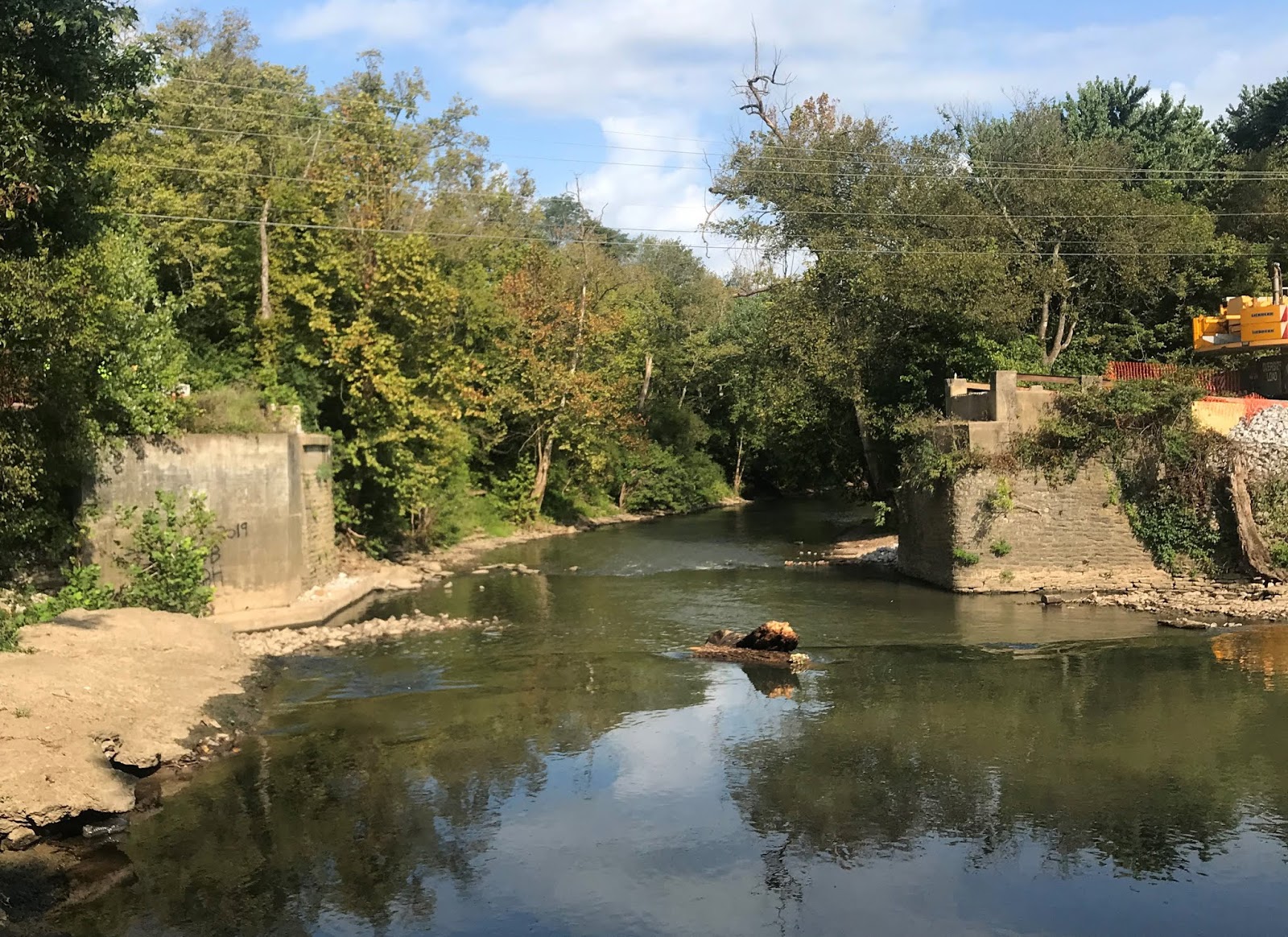
Work began this week on the new bridge over South Elkhorn Creek at Weisenberger Mill. This photo, looking south from the mill side, shows construction of a temporary road for a crane that will be used to remove the 1935 bridge for replacement with one of a similar style. The state Transportation Cabinet says the work by Louisville Paving Co. is expected to be completed by May 2020. The bridge has been closed for safety reasons since July 1, 2016, and its replacement was delayed mainly by required historical and environmental studies.

Wednesday, August 7, 2019

New Weisenberger Mill bridge set for completion by May

A new Weisenberger Mill bridge should be open by May 2020, the state Transportation Cabinet announced today after meeting with the contractor on the project.

"Preliminary operations begin Monday, August 12," the cabinet said in a news release. "The public will be informed of progress toward the replacement bridge through advisories furnished to media outlets." The first step will be removal of the old bridge, which has been closed for more than three years, blocking a popular tourist and commuter route and delaying emergency responses.

Louisville Paving Co. Inc. was the sole bidder for the project through two rounds of bidding. Its latest bid of $877,000 was almost 42 percent above the state engineers' estimate, but that was a big improvement over the first bid of $1.95 million, 2¾ times a somewhat higher estimate.

The cabinet decided Friday to accept the bid; it will spend an additional sum for "soil nailing," insertion of reinforcing bars into the banks of South Elkhorn Creek. That part of the work was removed from the bid documents and made part of an overall contract the state has issued for such work.

1935 photo of the bridge (Kentucky Transportation Cabinet)
The bridge was closed July 1, 2016, after state inspectors found advanced deterioration in the lower chord of the truss. The new bridge will be a "pony truss" style like the current one, which is 72 feet long and 12 feet wide. The truss spans about 40 feet. 

Replacing the one-lane span, which dates to 1935, has been complicated. The first plan, in 2013, was for a two-lane bridge, but the cabinet changed it to a one-lane pony truss in response to public concern that a modern concrete span would detract from the scenic nature of the site and encourage speeding, causing accidents in the sharp curve on the Woodford County side.

"The newly constructed bridge will fit within the context of the environment," the news release said. "It will also provide a solution for safe travel to be utilized by citizens and emergency management vehicles."

Since the bridge has historical significance and is a state responsibility, the project had to undergo review by the State Historic Preservation Office and the Kentucky Heritage Council, as well as an environmental impact report to federal officials. Initial bidding on the project was delayed a month by negotiations over construction easements.

The bridge links Woodford and Scott counties. It is nominally Woodford's responsibility, under a longstanding agreement between the counties, but the state agreed to take responsibility for it several years ago.

The bridge's closure has further isolated the largely African American community of Zion Hill, at the southern tip of Scott County. Woodford County has been providing emergency services to the area.

Friday, August 2, 2019

State accepts sole bid for Weisenberger Mill bridge; job to take 6 to 9 months but starting date is not set yet

The bridge, the historic mill and the creek in June
The state Transportation Cabinet decided Friday to accept the sole bid of $877,000 for the long-delayed replacement of the Weisenberger Mill Bridge.

Louisville Paving Co. was again the sole bidder. Its bid was almost 42 percent above the state engineers' estimate of $618,959, but that was much closer than its first bid: $1.95 million, 2¾ times the estimate of $709,889. The estimate was lowered because part of the project was made part of an overall contract the state has issued for certain work.

Construction is expected to take six to nine months, but a starting date has not been set. That will be discussed at a pre-construction meeting at the cabinet's District 7 office in Lexington, said Natasha Lacy, public information officer for the district.

The bridge across South Elkhorn Creek, the border of Woodford and Scott counties, is nominally Woodford's responsibility, under a longstanding agreement between the counties, but the state agreed to take responsibility for it several years ago.

Heavy trucks taking shortcuts have been blamed for wearing down the bridge. The state closed it July 1, 2016, after inspectors found it was not safe for a load of three tons.

Replacing the one-lane span, built in the early 1930s, has been complicated. The first plan was for a two-lane bridge, but the cabinet changed it to one lane, with the pony-truss style of the old bridge, to assuage public concern that a modern concrete span would detract from the scenic nature of the site and encourage speeding, causing accidents in the sharp curve on the Woodford County side.

Since the bridge has historical significance and is a state responsibility, the project had to undergo review by the State Historic Preservation Office and the Kentucky Heritage Council, as well as an environmental impact report to federal officials. The project was delayed at least a month by negotiations over construction easements.

The bridge's closure has further isolated the largely African American community of Zion Hill, at the southern tip of Scott County. Woodford County has been providing emergency services to the area.

Friday, July 26, 2019

Weisenberger Mill bridge project gets same bidder, lower price, but still well above engineer's estimate

The second round of bidding for a new Weisenberger Mill bridge drew the same lone bidder, who bid much lower but still well above the estimate of state Transportation Cabinet engineers.

Louisville Paving bid $877,000 for the work, almost 42 percent above the estimate of $618,959. Still, that was a big improvement over the first bid: $1.95 million, 2¾ times the estimate of $709,889. The estimate was lowered because the soil-nailing part of the project, insertion of reinforcing bars into the creek bank, was removed and made part of an overall contract the state has issued for such work.

The Transportation Cabinet is expected to decide in about a week whether to accept the bid for the long-delayed project to replace a bridge that was closed more than three years ago.

After the first bid, Woodford County Magistrate Jackie Brown said Kelly Baker, the chief engineer at the cabinet's District 7 office in Lexington, told him that Louisville Paving bid on foundation work they would not have to do, and expected that a rebid would be much closer to the estimate.

The bridge across South Elkhorn Creek, the border of Woodford and Scott counties, is nominally Woodford's responsibility, under a longstanding agreement between the counties, but the state agreed to take responsibility for it several years ago.

The state closed the bridge July 1, 2016, after inspectors found it was not safe for a load of three tons. The state had already lowered the limit twice in an effort to turn away heavy trucks whose drivers used the bridge for a shortcut to or from Interstate 64.

The bridge's closure has further isolated the largely African American community of Zion Hill, at the southern tip of Scott County. Woodford County has been providing emergency services to the area.

Replacing the one-lane span, built in the early 1930s, has been complicated. The first plan was for a two-lane bridge, but the cabinet changed it to one lane, with the pony-truss style of the old bridge, to assuage public concern that a modern concrete span would detract from the scenic nature of the site and encourage speeding, causing accidents in the sharp curve on the Woodford County side.

Since the bridge has historical significance and is a state responsibility, the project had to undergoreview by the State Historic Preservation Office and the Kentucky Heritage Council, as well as an environmental impact report to federal officials. The project was delayed at least a month by negotiations over construction easements.

Monday, June 24, 2019

Sole bid on new Weisenberger Mill Bridge may be too high for state to accept, state says 'there was no error'

The bridge is a scenic, historic spot due to the mill, built in 1913 on the site of an 1865 mill, and its dam on South Elkhorn Creek.
This story has been updated.

The only bid for construction of a new Weisenberger Mill Bridge was almost three times the engineers' estimate, raising the possibility that the bid will be rejected and the project further delayed. The bridge will have been been closed for three years as of next Monday.

The bid by Louisville Paving Co. was $1.95 million, 2¾ times the estimate of $709,889. The Awards Committee of the Kentucky Transportation Cabinet is scheduled to consider the bid and others from Friday's bid letting at 9:30 a.m. Friday. (The meeting is exempt from the state Open Meetings Act.)

Woodford County Judge-Executive James Kay told the Midway Messenger that his office had heard from Kelly Baker, the chief engineer at the cabinet's District 7 office in Lexington, "that the bid may have been a mistake." District 7 spokeswoman Natasha Lacy said in an email that Baker "has not talked with Judge Kay about this. In addition, there was no error." Kay said in an email, "Magistrate Jackie Brown spoke with Kelly Baker and relayed that info to me."

Brown told the Messenger Tuesday evening that Baker told him Louisville Paving bid on foundation work they would not have to do, and expects a rebid would be much nearer to the engineers’ estimate.

Told that, Lacy sent an email Wednesday saying, "The existing abutments are being left in place for the project. The design calls for placing a soil-nail wall around the abutments . . . to sufficiently protect and strengthen them. If the bid is rejected, we will discuss the possibility of separating out this part of the project. It then [could] be completed through maintenance agreements that we have in place. The remainder of work for the bridge would be placed back out for bid."

The bridge across South Elkhorn Creek, the border of Woodford and Scott counties, is nominally Woodford's responsibility, under a longstanding agreement between the counties, but the state agreed to take responsibility for it several years ago.

The state closed the bridge on July 1, 2016, after inspectors found it was not safe for a load of three tons. The state had already lowered the limit twice in an effort to turn away heavy trucks whose drivers used the bridge, apparently following Global Positioning System directions for a shortcut to or from Interstate 64, using Paynes Depot Road and perhaps Big Sink Road.

The state could ask the county to share in the unexpectedly high construction cost, but Kay said he doubted that the Fiscal Court would be willing to do that, even with a contribution from Scott County.

Magistrate Liles Taylor, who represents the Midway area on Fiscal Court, said he expects the state to keep its commitment to replace the bridge, and said the top concern must be public safety, but "Everything's on the table."

The bridge's closure has further isolated the largely African American community of Zion Hill, at the southern tip of Scott County. Woodford County has been providing emergency services to the area.

Replacing the one-lane span, built in the early 1930s, has been complicated. The first plan was for a two-lane bridge, but the cabinet changed it to one lane, with the pony-truss style of the old bridge, to assuage public concern that a modern concrete span would detract from the scenic nature of the site and encourage speeding, causing accidents in the sharp curve on the Woodford County side.

Since the bridge has historical significance and is a state responsibility, the project had to undergo review by the State Historic Preservation Office and the Kentucky Heritage Council, as well as an environmental impact report to federal officials. The project was delayed at least a month by negotiations over construction easements.

Wednesday, May 15, 2019

State gets final construction easement, will advertise new Weisenberger Mill Bridge for June 21 bid letting

Last June, weeds grew in the road near the bridge, which at that time had been closed for nearly two years. (Sarah Ladd photo)
By Al Cross and Kristi Fitzgerald
University of Kentucky School of Journalism and Media

The state Transportation Cabinet is preparing to advertise for bids to replace the Weisenberger Mill Bridge, after purchasing a construction easement from mill owners Mac and Sally Weisenberger — and deciding it didn't need an easement from Bryan and Julie Pryor, who live catercorner from the historic mill and the bridge across South Elkhorn Creek.

The project is in the cabinet's June 21 bid letting. That means it likely won't be completed until 2020, disappointing those who are upset about the fact that it has been closed since July 1, 2016, but it will bring to an end a controversy that has lasted most of the decade.

In any event, the Weisenbergers and the Pryors are still not happy with the state.

"I got tired of arguing with them, or just dealing with them," Mac Weisenberger told the Midway Messenger. "And the community here needs a bridge. I didn't want to be accused of holding this thing up."

Weisenberger's easement became the only remaining obstacle to the bid letting after the Transportation Cabinet decided that it could do the project without a temporary construction easement from Pryor.

The Pryors' rock wall is only inches from the road in places.
Pryor said state officials came to an April 26 meeting with a letter saying his easement was no longer needed, though "We were there to talk about solutions to my concerns. They quickly changed the conversation." The cabinet said it does not comment on negotiations.

Both couples have issues with the state that go beyond its need for the easements. Pryor said at a public hearing in August that he is obligated by a historic easement to preserve the wall surrounding his property, made partly of worn-out millstones from the mill. He said today that he is concerned about construction taking place near the wall, which is being undercut by drainage from the road.

The drainage is an issue for the Woodford County Fiscal Court, because Weisenberger Mill Road is a county road. The county is responsible for the bridge, but the state is doing the project in return for Woodford County doing a bridge project in Millville several years ago.

The 89-year-old bridge, a popular scenic spot, was closed on July 1, 2016 due to its old and unsafe steel infrastructure, damaged by trucks crossing while exceeding the weight limit.

The Weisenbergers have voiced concern that plans for the new bridge call for its opening to be two feet narrower than the current one, raising fears that their mill would be in greater danger of water damage when the creek is in flood. When Mac Weisenberger raised that concern, Project Manager Casey Smith said state engineers looked at that, and “They did not see a significant rise out of it.”

Weisenberger then wrote the state, “Where is the proof this won’t cause additional flooding? We haven’t see any report. We will wait until you present us with a No Rise Certification and proof that vibration won’t cause ANY damage now or in the future to the Mill building, equipment, machinery, employees and/or dam. Do you really think we, Weisenberger Mill, will just sit back and not demand reasonable answers?” In capital letters, he added, “We have a business to protect!”

He also wrote, “We have been frustrated beyond belief throughout this project. . . . Everyone who utilizes the bridge is totally frustrated with the delays of this project.”

The process of replacing the one-lane bridge has stirred controversy and undergone several changes. The state’s first plan was for a two-lane bridge, but changed that to one lane after the public voiced concerns that would detract from the scenic, historical site and cause accidents in the sharp curve on the Woodford County side of Weisenberger Mill Road.

The design of the bridge, and the delay in replacing it, have sparked much debate. Since the bridge has historical significance and would be replaced by the state, the project had to undergo review by the State Historic Preservation Office and the Kentucky Heritage Council, as well as an environmental impact report to federal officials, all of which have pushed back construction, which is expected to take six to nine months.

Mapquest map, adapted, shows how the bridge closure has isolated Zion Hill.
Last year, state officials said they expected construction in 2020, but said there was a chance it could be done in 2019. They put it in the April 26 bid letting, with a tentative advertisement date of Saturday, April 6, and a deadline of April 3 to be in the ad. Then they moved it to the May 24 letting, but the Weisenberger easement wasn't ready in time, so the project now set for letting June 21.

"I’m optimistic that the project is moving forward and will not see any further delays," said Magistrate Liles Taylor, who represents the Midway area on Fiscal Court.

The bridge closure has complicated access for residents of Zion Hill, a largely African American community at the southern tip of Scott County. Woodford County has been providing emergency services to the area.

Monday, April 1, 2019

Weisenberger Mill bridge ready for bids, except for construction easements, held up by lingering issues

Last June, weeds grew in the road near the bridge, which at that time had been closed for nearly two years. (Sarah Ladd photo)
This story, originally published April 1, has been updated.

By Kristi Fitzgerald
University of Kentucky School of Journalism and Media

The Kentucky Transportation Cabinet wants to advertise the new Weisenberger Mill Bridge for bids this week, but lack of temporary easements for construction could delay the project.

The bridge was among the projects in the cabinet’s April 26 bid letting, with a tentative advertisement date of Saturday, April 6, and a deadline of April 3 to be in the ad. Negotiations for the final two construction easements continue, according to Natasha Lacy, a public information officer at the cabinet’s District 7 office in Lexington.

Lacy said the project has been moved to a May 24 bid letting, with a tentative advertisement date of May 3. If the easements are not purchased three weeks prior to the letting date, the project will be moved to August.

That would push completion of the new bridge until 2020. Construction is estimated to begin about one month after the bid letting and to be completed six to nine months after construction begins, Lacy said. Two of the four construction easements have been purchased, she said.

The holdouts are Mac and Sally Weisenberger, owner of the historic mill for which the bridge is named, and Bryan and Julie Pryor, who live in a recently built home catercorner across South Elkhorn Creek from the bridge. Both couples have issues with the state that go beyond its need for the easements.

Bryan Pryor said at a public hearing in August that he is obligated by a historic easement to preserve the wall surrounding his property, made partly of worn-out millstones from the mill. He said this week that the easement extends his property line to the middle of the road.

The rock wall on the Pryors' lot uses worn millstones from the mill.
At some places, the wall is within inches of the pavement.  It was damaged a few years ago by one of the many tractor-trailers that have been guided to the bridge when their drivers seek shortcuts without regard to the bridge’s weight limit or the limited capacity of the roads leading to the bridge.

The Pryors said they need to be cautious about public statements because their situation is more complicated than it appears.

“We are not prepared to have construction right-of-way discussions with the state until protective solutions for the wall and issues concerning the usage easement across our property, to the bridge, are resolved with Woodford County,” they said in an email. “The state Transportation Cabinet has repeatedly said the project is from bridge end to bridge end, and that approachways were not part of the project.  Conversations with Woodford County are still in process but not concluded.”

Woodford County Magistrate Liles Taylor, who represents the Midway area, said he and County Judge-Executive James Kay and County Attorney Alan George are not only trying to work out those issues, but find an overall solution that will get the bridge built as soon as possible.

Mill owner Mac Weisenberger declined to comment other than to say, “I am hopeful that the bridge will be completed this year.”

Weisenberger has voiced concern that plans for the new bridge call for its opening to be two feet narrower than the current one, raising fears that his mill would be in greater danger of water damage when the creek is in flood. When he raised that concern with Project Manager Casey Smith last June, Smith said state engineers looked at that, and “They did not see a significant rise out of it.”

Weisenberger then wrote the state, “Where is the proof this won’t cause additional flooding? We haven’t see any report. We will wait until you present us with a No Rise Certification and proof that vibration won’t cause ANY damage now or in the future to the Mill building, equipment, machinery, employees and/or dam. Do you really think we, Weisenberger Mill, will just sit back and not demand reasonable answers?” In capital letters, he added, “We have a business to protect!”

Weisenberger also wrote, “We have been frustrated beyond belief throughout this project. . . . Everyone who utilizes the bridge is totally frustrated with the delays of this project.”

The replacement of the bridge has been a topic of concern for about six years and even more so since its closing on July 1, 2016. The bridge was built around 1930 and was closed due to its old and unsafe steel infrastructure, damaged by trucks crossing while exceeding the weight limit.

The bridge is on a county road, but the state is doing the project in return for Woodford County doing a bridge project in Millville several years ago. The creek is the Scott-Woodford county line; under an agreement with Scott County, Woodford is responsible for maintaining the bridge.

The process of replacing the one-lane bridge has undergone several changes drew the attention of and surrounding residents.  The state’s first plan was for a two-lane bridge, but changed that to one lane after the public voiced concerns that would detract from the scenic, historical site and cause accidents in the sharp curve on the Woodford County side of Weisenberger Mill Road.

The design of the bridge, and the delay in replacing it, have sparked much debate. Since the bridge has historical significance and would be replaced by the state, the project had to undergo review by the State Historic Preservation Office and the Kentucky Heritage Council, as well as an environmental impact report to federal officials, all of which have pushed back construction.

Mapquest map, adapted, shows how the bridge closure has isolated Zion Hill.
Last year, state officials said they expected construction in 2020, but said there was a chance it could be done in 2019.

“I’m thrilled that we are this much closer to getting this project started and hopefully completed this year — three years after the bridge was closed,” Taylor said.

“With recent flooding on Browns Mill Road, the isolation of area residents is more clear than ever,” Taylor said. “Completion of this project is first and foremost vital for public safety, impacting emergency response times and access on both sides of the bridge.”

Browns Mill Road, Old Frankfort Pike and Paynes Depot Road have been used as alternate routes to access Zion Hill, a largely African American community, since the bridge was closed.

Isaac Hughes, a Zion Hill resident, expressed his concerns about the possible delay of the project, saying that he is “worried that the easements for the right of way will hold things up even further.”

Friday, August 10, 2018

Officials say they hope to replace mill bridge next year, but community members are skeptical

About 80 people attended the meeting in the gymnasium of Northside Elementary School in Midway.
Story and photos by Sarah Ladd
University of Kentucky School of Journalism and Media

Community members heard a hopeful timeline but remained skeptical after an information session on the Weisenberger Mill Bridge project Thursday.

The meeting was held from 6 to 8 p.m. in the gym at Northside Elementary School, where officials from the state Transportation Cabinet met with around 80 community members to discuss the details of the project. Booths were set up with information on design, construction, the environmental process and acquiring right of way. At each booth, officials for that part of the project discussed details and answered questions. Each booth had blank posters for citizen to write comments.

Project Manager Casey Smith discussed the bridge design.
The design for then new bridge remains the single lane truss favored by the public at a June 9 hearing. Project Manager Casey Smith said he encountered mixed emotions from the community at Thursday’s meeting, but said, “What is consistent is that people want the bridge open.” Smith said when he and others began the project, they did not realize it would be as controversial as it has been. He and other officials said construction could possibly begin in the spring of 2019. The project is expected to take one construction season.

First, the environmental review document must be completed, which Smith said is being wrapped up now. Tim Foreman, the environmental project manager, said he hopes it can be completed in November or December. Next, the state will focus on purchasing easements for the right of way, said Diane Forrester with the Division of Right of Way and Utilities, which she said could be done by March. But, she said, the time frame may be altered by other factors. “It’s all very preliminary right now,” she said.

Liles Taylor, who won the Democratic primary for Midway district magistrate in May, said he has concerns about resources. “It’s very encouraging if the timeline we’re hearing is legitimate,” he said, but said the timeline puts work before July 1, the start of next fiscal year, and he is concerned about state budgeting.

“The Road Fund is already over-programmed,” he said, “to the point that there’s more budgeted than is actually in the Road Fund. So to say that they’re gonna actually literally not follow what is in the current Road Plan and fund something that is not set for another year is a pretty bold thing.” He said he’s interested to see how the funds are freed up, and, “I’m hoping we’ll have a pleasant surprise on that.”

Isaac Hughes discussed the process with state officials.
Isaac Hughes, who lives in Zion Hill, the community mostaffected by the bridge’s two-year closing, said he and others in the community “will not feel good about it until we actually see them breaking ground. We’re not happy because we’ve heard this before.” He said they are worried that the easements for the right of way will hold things up even further and wishes that part of the process had already been done. State officials have said they can’t acquire right of way or construction easements until the environmental review is completed.

Hughes said if the timeline stays as is and he sees progress in April 2019, he will be glad. “But looking at the process, I think it needs to be changed because it’s one-sided. … It’s not only the bridge I’m concerned with. It’s how we as Kentuckians and Americans are doing people. Their ‘process’ is not for the people.” Hughes said he watches other projects being completed and feels the bridge that has cut off his community is being put on the back burner because “it’s land value over people value.”

He also said Scott County ambulances s still have to go around the closed bridge and the counties are still more worried about logistics than people’s lives. “It’s almost like you’re holding a gun to someone’s head and your waiting for it to go off. The state has a chance to get the gun out of his hand. But they’re letting him hold the gun and wait until something bad happens. When something bad happens, that’s when we’ll all come together and say ‘hey, we need to do something.’ We needed to do something two or three years ago.”

Phil Weisenberger on the bridge at his family's mill
(2015 photo by Jamilyn Hall)
Phil Weisenberger, who works at his family’s Weisenberger Mill, said it is good that the team has decided on a single-lane bridge for safety reasons and traffic-speed control. “I think that’s the best option for that area.”

Weisenberger said the process has taken so long that he is numb to it in many ways. Though he said he tries to look at the bright side, he knows people are frustrated and the project team must be tired of answering the same questions.

He said with the bridge in two counties, state responsibilities and federal money, “It’s the mother of all government projects that have come together to make it a slow, slow thing. I’ll believe it when I see it. But it looks like there is light at the end of the tunnel.” He said he won’t get his hopes up until work is physically being done, but he said he feels the project is on the right track.

Saturday, June 9, 2018

Meeting about bridge offers little hope for fast reopening

Isaac Hughes of Zion Hill makes a point to consulting engineer Phil Logsdon and others at Thursday's meeting.
By Sarah Ladd
University of Kentucky School of Journalism and Media

A consulting board’s meeting Thursday offered no solutions for a quick reopening of the Weisenberger Mill Bridge, but a small glimmer of hope that it could be rebuilt next year, not in 2020.

The meeting at Northside Elementary School was for people who had signed up to be consulting parties on the project, required under federal environmental and historic-preservation laws. It was also open to observers, most of whom were more concerned about the need to reopen the bridge, which has been closed since July 1, 2016, isolating the Zion Hill community.     

Casey Smith, project manager for the state Transportation Cabinet, opened the meeting by addressing concerns the community expressed in a meeting at the bridge Tuesday, including the feeling that its voices are not being heard. “It hurts to hear that,” he said. “Despite all the emotion and frustration, I find this process is actually working.”

Craig Potts, the state historic-preservation officer, said the process has already resulted in giving residents of the area the alternative they wanted – a one-lane bridge like the old one, for fear that a two-lane span would encourage more speeding and heavy truck traffic.

Federal Highway Administration environmental specialist
Eric Rothermel listened at the meeting. (Photo by Sarah Ladd)
Potts said the Federal Highway Administration “said it didn’t build one-lane bridges,” for safety reasons, but FhWA Environmental Protection Specialist Eric Rothermel, who joined the project around a year ago, was able to get his superiors to accept the single-lane alternative. (Rothermel declined to comment afterward, saying he wasn’t allowed to speak to news media.)

Potts said, “We really benefited. . . . Otherwise we probably would have a two-lane alternative underway right now.” That was the plan when the bridge was closed for safety reasons.

Phil Logsdon, senior project manager at H.W. Lochner, the Lexington engineering firm advising the state, said part of the meeting’s purpose was to eliminate the two-lane alternative. He said it can’t be officially eliminated until a decision is made, but the community has made it clear that it wants the single-lane alternative.

The conversation turned to a debate over whether a single-lane bridge could be 14 feet wide, as opposed to the current 12-foot plan, to accommodate more farm machinery. Engineers at the meeting said both options should have the same weight limit of 40 tons.

Magistrate Chad Wallace of Scott County’s Third District asked if making it two feet wider would delay the process. “The general feel is to get something open as soon as possible,” he said.

Logsdon was unsure, but several members of the state's project team – 18 were in attendance – said consideration of the 14-foot alternative was unlikely to delay the process.

Wallace asked the question likely on the minds of most: “How soon do we get a bridge?”

Mapquest map, adapted, shows how the bridge closure has isolated Zion Hill.
The bridge is not scheduled to be completed until 2020, but Logsdon and state officials outlined a scenario that might get it done next year: After the official comment period ends July 9, if support for a one-lane bridge remains strong, he said, “It’s going to make it a lot easier for the Transportation Cabinet to make that decision.” He said the project timetable calls for FHwA to approve the project’s environmental document in December, after which the state could start acquiring property easements it needs for construction devices. The federal fiscal year does not begin until Oct. 1, 2019, but if money became available before then due to delays in other federally funded projects, “cabinet leadership” could move up the schedule and seek bids.

Later, Isaac Hughes of Zion Hill asked who heads the cabinet, and was told that is Secretary Greg Thomas. Hughes said the process he saw at the meeting won’t get a bridge built soon. At Tuesday’s meeting, he voiced concern that the process is focused more on the design of the bridge than its speedy reopening.

After the meeting, Hughes said his concerns have not been resolved. “We’re still looking at the process,” he said. “It’s about the process, not the people.”

Hughes said other communities nearby have repaired bridges in a speedy manner. “Those communities had horse industry money,” he said, and Zion Hill doesn’t produce much revenue, so there is little incentive to repair the bridge.

“It’s about land value, not life value,” he said, echoing his concerns from Tuesday, and said he feels the community means nothing to those working on the bridge repairs.

Soon after the meeting started, the cabinet’s environmental-analysis director, Danny Peake, told the crowd that the process “probably seems cumbersome, slow and painful,” but has seen “a large government agency” change its plans in response to public concern.

About halfway through the meeting, Ed Courtney, part of whose property would be used for a construction easement, said, “They built that bridge probably in less time than you all been talking about it.”
Project Manager Casey Smith, right, talks with mill owner Mac Weisenberger, who voiced concern that the new bridge abutments would reduce the width of South Elkhorn Creek by two feet, which he said would worsen flooding. Smith said state engineers looked at that, and “They did not see a significant rise out of it.” Weisenberger asked Smith if he had seen the creek in flood; Smith said he had seen pictures from Weisenberger. At left is state historic preservation officer Craig Potts.