Header

Monday, December 29, 2014

Midway student from Georgetown wins her class's clinical award; Austin Bowman gets freshman award

Christina Martin
Christina Martin of Georgetown, who received her nursing degree from Midway College this month, is the winner of her class's Clinical Award. The award is given to a student who maintains a grade-point average above 3.0 and is able to effectively translate classroom theory to safe and competent clinical practice at the bedside, according to a college news release.

"Christina's performance in clinical practice is excellent and demonstrates critical thinking, intuition and utilizes nursing knowledge," said Dr. Barbara Kitchen, dean of the college's School of Health and Sciences. "She also exhibits a high level of integrity, provides relationship-centered care, utilizes clinical judgment and integrates best evidence into practice."

Midway College offers associate and bachelor's degrees in nursing on its campus in traditional daytime and accelerated evening formats that prepare students to become registered nurses in a variety of clinical settings, the news release said.

Austin Bowman of Midway won the college's Outstanding Freshman Award for December 2014. The award is presented to an exceptional freshman nursing student who has embraced the field with a passion. Recipients must maintain a grade-point average above 3.0, exhibit a high level of integrity, demonstrate a spirit of inquiry, be a compassionate and therapeutic communicator, and be professional in attitude behavior and appearance.

Dr. Barbara Kitchen, Dean of Midway's School of Health and Science, says Bowman exhibits these traits and more: "Austin has been outstanding in the clinical area by always being a team player and demonstrating an eagerness to learn. He has a great rapport with his peers and quietly leads by example."

Monday, December 22, 2014

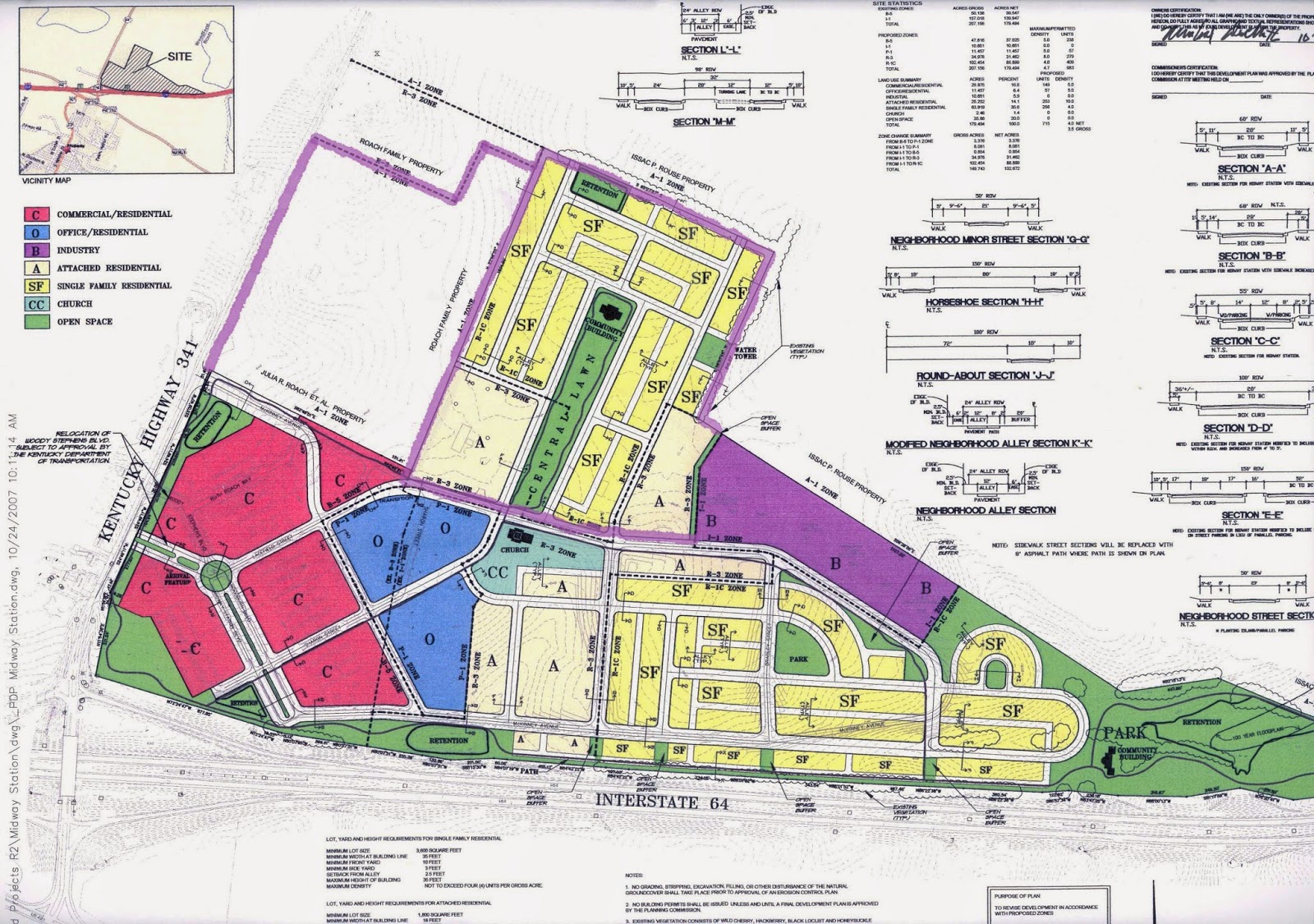
Ordinance allowing Midway Station redevelopment with tax-increment financing passes; county action next

The Midway City Council gave final approval Monday morning to the ordinance that will allow redevelopment of Midway Station by paying for public infrastructure improvements with the increased tax revenue from the development.

Approval came quickly, as soon as city attorney Phil Moloney read the lengthy title of the complicated tax-increment financing ordinance. All five council members present voted for it; Sara Hicks was absent.
Council members raise hands to vote for TIF as attorney Moloney, Mayor Bozarth and City Clerk Phyllis Hudson look on.
The TIF ordinance authorizes 80 percent of the new property and payroll taxes generated at Midway Station (not including school and fire taxes) to be used to pay the estimated $31 million cost of redeveloping its public infrastructure: parking areas, streets, sidewalks, utilities and so on, as well as the associated costs of demolishing the existing infrastructure, which was designed for an industrial park.

The park has generated only about 10 jobs, leaving the city and Woodford County with $4.7 million remaining in debt from the $6 million in bonds issued for purchase of the property and its development.

Lexington developer Dennis Anderson is paying the $11,400 monthly interest on the bonds in return for an option to buy and develop the property as commercial and residential, under an agreement with the property owner, the Woodford County Economic Development Authority.

Some of the property, and an adjoining tract on which EDA has an option, was recently rezoned back to industrial to help attract one or more industrial prospects, such as a supplier plant for the Toyota Motor Manufacturing Corp. complex at Georgetown.
Optioned tract recently zoned industrial is white outlined in purple. Area earlier rezoned industrial for prospective factory is mainly yellow outlined in purple. Area in solid purple has been zoned industrial since original development of Midway Station.
County Judge-Executive John Coyle said recently that he expects the county fiscal court to join with the city in applying to the state for approval of the TIF district, which would funnel county taxes to it as well as city taxes and state property taxes.

Anderson has said he has secured private financing for what would be a $126 million project, with development lasting as long as 20 years, the maximum life of a TIF district. His consultants estimate that the project will generate $94 million in tax revenue over 20 years.

Under the ordinance, the mayor will be primarily responsible for overseeing the TIF district and its finances. Midway will get a new mayor on Jan. 1, one-term Council Member Grayson Vandegrift, replacing Mayor Tom Bozarth, who did not seek re-election to a third four-year term.

"Thank you very much," Bozarth said as he adjourned his last meeting as mayor. "It's been a pleasure and a joy. Hallelujah."

Council Member Bruce Southworth told Vandegrift after the ordinance passed, "Here's the ball; it's the handoff."

Vandegrift told reporters after the meeting that TIF appeared to be the only way to get Midway Station off dead center. He said he doubted that a developer would be available without such incentives.

"The only disagreement I heard from people about the TIF [district] was a philosophical disagreement as to whether taxpayer money should be used in this way," he said, adding that was a question for state legislators, who passed the law allowing it.

Asked if the city would have approved TIF if it were not on the hook for half of the bonded indebtedness, he said, "I'm sure it had something to do with it."

He added later, "The fear is, if we let this go down, it is just going to sit there for another 20 years. . . . I don't know of anybody who doesn't want Midway Station to do something . . . especially given the fact of how much money we owe."

Vandegrift concluded, "This whole Midway Station thing has been a long, really, nightmare. We've got a chance to get it moving. . . . This is going to be the kind of slow, sustainable growth that we're looking for."

Friday, December 19, 2014

Council gives first reading to tax-increment financing for redevelopment of Midway Station; passage set Monday

By Nicole Hennard
University of Kentucky School of Journalism and Telecommunications

The Midway City Council had a special meeting Wednesday morning to give first reading to the tax-increment financing ordinance for Midway Station, after delays in production of documents prevented action at Monday's regular meeting.

Attorney Doug Martin and his law partner, city attorney Phil Moloney, presented a package of documents, some of which are posted online with the proposed ordinance. They included a development area description and map; a development plan; a pending interlocal cooperation agreement with Woodford County, which is expected to participate in the TIF district; a Local Participation Agreement between the city and Anderson Communities Inc., the Lexington developer that is paying the $11,400 monthly interest on the $4.7 million in bonds still outstanding on the property in return for the option to buy it; a master development agreement between the city and the developer; and a report from Anderson's consultant, Commonwealth Economics, forecasting the progress of development and generation of tax revenue.

Eighty percent of the additional property- and payroll-tax revenue created by the development will be dedicated to reimbursing Anderson $31.5 million for development of public infrastructure and payment of fees to create the TIF district.

Martin said the investments in the project will total $126 million and are expected to take place over a 20-year period. The project is expected to support over 4,000 jobs annually and have $7 billion in statewide economic impact.

“Any new taxes that flow from the area will be allocated to infrastructure, administrative costs, and redevelopment assistance related to the development area,” Martin said. “The report estimates that over a 20-year period, the project will generate approximately $93.8 million in tax revenue.”

The documents make clear that the office of the mayor is the agency responsible for oversight, administration and implementation of the ordinance and special fund. The ordinance is being passed shortly before mayor elect Grayson Vandegrift’s term begins at the start of the new year.

The council scheduled a special meeting for Monday, Dec. 22, at 8:30 a.m. to give second reading and passage of the ordinance.

The ordinance was drafted after months of discussion with the Woodford County Economic Development Authority (the land owner) and developer Dennis Anderson, who is paying the interest on the bonds that financed development of the industrial park (which has largely failed).

Included in the ordinance is a requirement that the city receive 2 percent of the fund’s disbursements to cover administrative costs. The council questioned whether that would be enough to cover such expenses as legal and accounting fees. Martin said that if the 2 percent was not adequate, the city would be reimbursed from the special fund.

Council Member Sharon Turner questioned who would establish the special fund. Martin said the office of the mayor would be in charge.

Council Member Bruce Southworth questioned whether the engineering review costs would be considered administrative. Martin and Moloney agreed that it would.

The city council will be responsible for reviewing and analyzing the process of the development from year to year.

The meeting concluded with a statement from Mayor Tom Bozarth: “We’ll meet Monday and move this along.”

Tuesday, December 16, 2014

Midway's new 'boutique' McDonald's is a test for the big corporation, franchisee Joe Graviss says

By Caitlin McPherson
University of Kentucky School of Journalism and Telecommunications

The McDonald’s restaurant opening at 10 a.m. Thursday in Midway is a guinea-pig store, testing out a ‘boutique’ approach for the world’s largest restaurant company, according to franchisee Joe Graviss.

Boutique, in short, means smaller. 

Graviss said Midway is finally ready for a fast food outlet, but this McDonald’s will be different than his eight others. 

The restaurant  has only 54 seats for dining, about half of the number of seats at a typical Graviss McDonald’s location. 

“They tried it years ago.  They kind of got away from it,” Graviss said of the approach. “I asked McDonald’s to come down three times to see if it made sense to put a restaurant at this interchange. . . . Three times I brought them down here and three times they said, ‘No, it’s not a viable market.  There’s not enough rooftops, not enough cars.’”

With the success of the Shell station and convenience store in the Green Gables development, Graviss said he asked the company to take another look. That, and perhaps a change in corporate management, changed McDonald’s mind, Graviss said.

Despite the small dining area, Graviss doesn’t expect drive-through customers account for any greater percentage of sales than a typical Graviss McDonald’s. He said his Nicholasville Road store gets 68 to 70 percents of its sales from drive-through.

Graviss’s ownership of the restaurant came as a surprise to many people in  Midway, partly because Green Gables developer Dennis Anderson spoke only of dealing with McDonald’s, not Graviss.

Graviss explained that McDonald’s had full control of the construction because the store is a test store for future boutique restaurants.

“McDonald’s wanted to keep control of all development cost,” he said. “They know that I like to spruce things up, for lack of a better term, so they wanted to control the spending and the cite and development cost 100 percent.”

Once McDonald’s achieved what they wanted, they handed control over the Graviss, he said, allowing him to make minor changes such as landscaping, locations of electrical outlets and access to USB portals. The restaurant has wi-fi for Internet access.

The manager of the store will be familiar to some in Midway. The manager of the Nicholasville Road store, Mary Husband, is coming home to supervise a staff of 45, about 30 of whom are from the Midway area, Graviss said.

“She is actually one of our younger tenured managers,” Graviss said.  “We are really proud of the fact that a lot of our team will be Midwegians.” 

The golden arches aren’t too far from Husband’s front door in the Northridge subdivision.  She said she hopes that her new job will give her a small role in helping the community.

“I think it will be just as busy as Nicholasville Road was, because there were a lot of other restaurants on Nicholasville that hurt us a little bit,” she said. “Here we have the interstate and all of Midway, so once we get established I think we can be right there with them.”

But is Midway ready for the arches to shine over the city's established, historic dining options? The fine dining options in Midway have made a name for the city. The Holly Hill Inn, the Heirloom and other restaurants downtown are quite the opposite from McDonald’s.

Graviss said his new restaurant will bring more people into Midway, and boost sales for the historic dining options and other downtown businesses.

One thing is for sure: Midway’s new neighbor is ready to serve the community.  The question is, is the community ready to welcome it? The ribbon-cutting for the restaurant will be held at 9 a.m. Thursday, with the first meals served at 10. On Wednesday from 5 to 7 p.m, a meet-and-greet limited to employees and their families will be held, to create a sense of community.
Left to right: Joe Graviss, Husband, Graviss McDonald's Restaurants Operations Director Jim Young
and Area Director Joe Allison stand on store sign before it was placed. (Photo submitted by Graviss)

Monday, December 15, 2014

TIF ordinance delayed; special meetings needed, starting Wed.; Bozarth hands out honors, recognition

The Midway City Council delayed action on a tax-increment financing ordinance for Midway Station after lawyers worked through the weekend to complete legal documents but didn't get them delivered until the council was adjourning its regular meeting Monday night.

The council scheduled a special meeting for 8:30 a.m. Wednesday to give first reading to the ordinance. Mayor Tom Bozarth said another special meeting would be scheduled to give final passage. Bozarth and two council members leave city government at the end of the year.

Doug Martin, a lawyer in city attorney Phil Moloney's firm, said the package of documents also includes a local development agreement, in which the city would agree to pledge its tax revenue from the area to projects and public infrastructure there; a master agreement with developer Dennis Anderson; and "probably an interlocal cooperation agreement" with Woodford County, which is expected to dedicate property- and payroll-tax revenue from the area to reworking its public infrastructure for business and residential development, the cost of which Anderson has estimated at $30.7 million.

John Soper, chairman of the Woodford County Economic Development Authority, which owns the largely failed industrial park, said he executed another extension of EDA's option agreement with Anderson Monday. Anderson is paying $11,400 a month interest on $4.7 million in principal remaining from the bonds that the city and county issued to develop the industrial park.

Soper said of TIF, "We think it's a bright spot, a way out of this thing, and we think it makes all the sense in the world for the stakeholders involved to put that TIF in place."

Since it was the council's last regular meeting of the year and his administration, Bozarth took time to thank and recognize council members and others for their work during the last eight years.

"We don't always agree, but at the end of the day we did agree on what's best for Midway," he said. "We ought to be proud of what we've accomplished." He told the council that was "not about me ... without you all we couldn't have gotten anything done."

Bozarth noted that the city has $35,000 in savings when he became mayor in January 2007, and now has now $600,000, with more than $1.5 million in cash at its last audit. "I challenge you to grow that," he said.

Bozarth will be succeeded by Grayson Vandegrift, who defeated fellow Council Member Sharon Turner in November. "It's good to have new ideas and new direction and I'm looking forward to sitting back and watching," Bozarth said. "It's been a great run for me; the friendships I've developed have been priceless. I want to wish each and every one of you good luck."

Tom Bozarth and Sharon Turner
After receiving a standing ovation from the council and others in attendance, Bozarth had the council adopt resolutions honoring the "sacrifice, hard work and passion" of Turner, retiring Council Member Aaron Hamilton and county Magistrate Larry Craig, who served on the council in 2003-06. "This town and its citizens have given a lot more to me than I've given to them," Craig said.

Turner didn't comment, but Hamilton said of his eight years on the council, "It has been a good run. I've enjoyed it. I'm really glad that I did it, for the friendships I've made and everything and I just want to thank everybody for your support."

Bozarth also gave keys to the city to Moloney, Woodford Sun correspondent and former police officer John McDaniel, and Midway Messenger publisher Al Cross, who lives in Frankfort and directs University of Kentucky students who cover Midway.

Donations to Ky. American Water's H2O (Help2Others) fund can help financially distressed customers pay bills

Kentucky American Water reminds customers of an opportunity to help families in need by donating to its H2O (Help to Others) program. The program is administered for the water company by Dollar Energy Fund in order to assist eligible customers in financial distress with their water bill payments.
The program is funded by donations from American Water shareholders and individuals.

To make a donation, customers check off the H2O box on the back of their bill, or donate directly to the program via Dollar Energy Fund’s website at www.dollarenergy.org.

To be eligible for H2O assistance, customers must have a total gross household income at or below 150 percent of the federal poverty level for that size household. Customers may apply for assistance at social service agencies in the region, including the Woodford County Community Development Office, 285 Beasley Rd., Versailles (873-8182); Catholic Charities of the Diocese of Lexington, Inc. 1310 West Main St., Lexington (253-1993) or United Way of the Bluegrass, 100 Midland Ave., Suite 300, Lexington (233-4460).

Wednesday, December 10, 2014

State's plans for Weisenberger Mill Road bridge are back up in the air after public objects to two-lane option

By Jackson Reams
University of Kentucky School of Journalism and Telecommunications

The rebuilding of the one-lane bridge on Weisenberger Mill Road has again been delayed due to the public’s opposition to a completely new bridge.

The bridge was built in 1930. (2013 photo by Nini Edwards)
The road winds its narrow way through farmland in Scott and Woodford counties with its namesake just inside Scott County. The 101-year-old Weisenberger Mill building sits on Elkhorn Creek, which is crossed by an old one-lane bridge with an almost 90-degree curve on the Woodford County approach.

The bridge has been marked for renovation or replacement since 2010, and a meeting was held in January 2013 to see what the public wanted done. The public preferred renovation, not replacement, so the state studied whether that was possible.

Ananias Calvin, the project manager, said in a recent interview that a crew was sent out to examine the bridge and found “extensive work” was needed, so only one solution made sense.

“We came to the conclusion that this bridge will probably be better if we just put in a new bridge,” Calvin said. The next step was to decide if the city wanted to go with the public’s preference of a one-lane or a two-lane bridge. “You have a two-lane road; why would you put a one-lane bridge back?” Calvin asked.

That question was answered, to state officials' dismay, at a second public meeting at Midway College Oct. 21 – a meeting that Calvin said the Transportation Cabinet wasn’t required to hold, but did to inform the public of the new direction they were taking.

“We wanted their response and we got it; they didn’t like it at all,” Calvin recalled. The answer to his question was: a one-lane bridge slows down traffic, a need on the narrow, curving road.

Debra Instone stands at her often-smashed fence in the curve.
Debra Instone’s Mill Creek Farm is on the outside of the 90-degree curve, where vehicles have repeatedly crashed through a wooden fence.

“If they make that two-lane and people know they don’t have to stop [for oncoming traffic that reaches the bridge first], the traffic’s gonna get faster,” Instone said in an interview at the site.

Instone said she has lived on the property for 11 years and someone has hit her fence “every year and this year three times.” She said, “It’s a huge responsibility if one of my horses get on this road. They don’t care if someone took my fence out, your horse is on here and someone hit it and got hurt; that’s my fault.”

Calvin said he agrees with Instone that there is a problem: “If you put in a two-lane bridge the speed will increase . . . because you don’t have to slow down to allow whoever was at the bridge across first.”

However he said a two-lane bridge would be as safe as a one-lane. “One was a traffic calmer,” he said. “The other one made it where two cars can go across at the same time.”

Instone and Philip Weisenberger III, son of mill owner Mac Weisenberger, said trucks trying to cross the 15-ton-limit bridge are also a concern. “There are trucks that get down here and realize they can’t get across the bridge,” he said. Instone said, “It takes them about 35 minutes to get turned around and get back to where they came.”

Weisenberger added, “All the trucks that come to our place turn around and back out, they never even cross. But I do see lots of trucks going through here.”

Instone and her husband Giles Instone said in a letter to Calvin that if a two-lane bridge goes in, they had four requests: “The current weight limit for vehicles remain in place… A blinking light be added to the 15mph sign… The existing metal guard rail be extended to the west to the width of the road… Raised bump strips [rumble strips] similar to those located on Old Frankfort Pike be installed on the road.”

Calvin said the new bridge, one-lane or two, will not deter traffic because the weight limit will no longer exist.  “If it goes any lower than that, it might be closed.”

Calvin said in a reply letter to the Instones that the blinking light and rumble strips are possibilities, but “Since this is a county road, we would have to work with the County Agencies concerning a blinking light, rumble strips (raised bump strips), and the extension of the guardrail around the curve.”

Woodford County had an agreement with Scott County to be responsible for the bridge, but got the state to take responsibility in return for the county working on a state bridge in Millville, according to outgoing Midway Magistrate Larry Craig.

The Kentucky General Assembly appropriated $500,000 for replacement of the bridge. That would not be enough to pay for a solution that has been suggested by several members of the public: move the bridge slightly downstream, to get the road away from the mill and line up the road with Paynes Depot Road, which intersects Weisenberger Mill Road on the other side of the curve from the bridge.
Likewise, Philip Weisenberger suggested in a letter to Calvin that “a small curve be added into the road.”

The mill attracts customers, tourists, photographers and fishers.
Calvin replied, “We have already looked at your idea of implementing a curve on the Scott County side but since it would have increased our construction cost beyond the amount budgeted, we decided not to.”

The Rev. Earl Raglin also lives just around the corner from the curve on Paynes Depot Road. He said in an interview he supports “ripping the bridge out and putting in a two-lane bridge” because “Quite a bit of traffic is flowing across that bridge and I’m afraid a one-lane bridge won’t accommodate that.”

But the views expressed at the meeting, and afterward, were strongly against a two-lane bridge, according to the state’s file on the matter. To download a 104-page PDF of the file, click here.

“After the public meeting my supervisor/branch manager, Robert Nunley, told us to step back and take another look,” Calvin said. “My timetable just changed; I have no idea what it is. I had one until the public meeting.”

Calvin said no ideas have been taken off the table, but the state is making sure that they are absolutely positive what they want to do before they move forward. Calvin said he doesn’t “know which way we are going to go but we are going to reevaluate it.”

The announcement that of the reevaluation pleased both Instone and Phil Weisenberger, who are fine with the current situation. “It wouldn’t bother me if they kept what’s here now,” Weisenberger said.

Calvin, however, says the damage done to the bridge and its supports means something must be done, but he is unsure of when that decision will come: “It would be really hard to give a schedule because we have been going back and forth so much.”

The next step could be putting more money for the bridge into the state’s six-year road plan, but that plan is adopted in even-numbered years and changing the state budget in odd-numbered years requires a 60 percent vote in each house of the General Assembly.

Several Midway leaders attended the meeting including Tom Mayor Bozarth, Mayor-elect and Council Member Grayson Vandegrift, outgoing Council Member and then-mayoral candidate Sharon Turner, and Council Member-elect Libby Warfield. In written comments, Warfield said she was “convinced that [a] 2 lane would be a mistake” and “create many new problems for this area.”

UPDATE: In a Dec. 10 letter to Calvin, Patrick Hagan of Weisenberger Mill Road asked that the bridge be restored to its original condition and said, "All you are doing is ruining our quiet, peaceful community."